

Bracelet stacking means wearing several bracelets together on one wrist, layered by design instead of piled on at random. The reliable formula: pick one anchor piece, then build outward to several bracelets total, mixing metal and texture on purpose rather than by accident. Odd numbers read more natural than even ones, and once you know the anchor, the rest of the stack almost arranges itself.
TL;DR:
- Most successful stacks use three to five pieces, with one large anchor piece and at least one contrast in metal, width, or finish.
- Mixing metals should follow rules like repeating each metal multiple times or adding a two-tone bracelet to ensure intentionality.
- Rigid bracelets provide structure in a stack, while softer chains and charms serve as accents, with placement emphasizing balance and contrast.
- Proper fit requires measuring bangles accurately to prevent slipping or bunching, using a two-finger rule for sizing and consistent stacking.
- Daily wear durability depends on material choice, with solid gold or silver resisting scratches better, and clasps and storage practices protecting the stack.
Table of Contents
- What Is Bracelet Stacking, and How Many Pieces Belong in One?
- How Do You Mix Metals, Textures, and Widths on Purpose?
- Which Bracelet Types Work Best in a Stack?
- How Do You Measure Bangles and Bracelets for a Comfortable Stack?
- Three Starter Stacks You Can Copy Today
- How Do You Keep a Bracelet Stack Looking Good All Day?
- How Trinity Carter Pieces Fit Into a Stack
- A Personal Note on Building Your Own Stack
- Where to Shop for Stackable Bracelet Pieces
- Sources
What Is Bracelet Stacking, and How Many Pieces Belong in One?
An anchor piece is the bracelet that sets the tone for everything else you add. A wide cuff, a tennis bracelet, or a chunky chain all work as anchors because they carry enough visual weight to hold the eye before the smaller pieces join in.
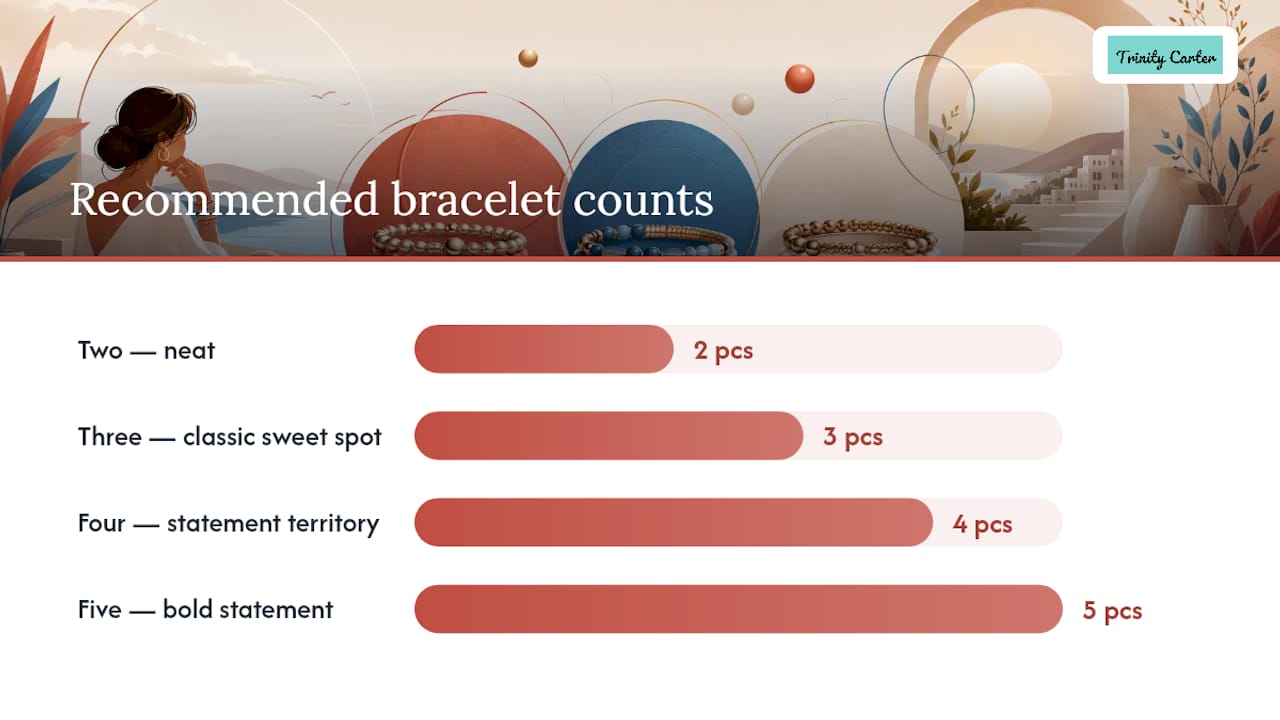
Counting from there is simpler than most people assume. Two bracelets look neat and low key. Three is the classic ratio, easy to wear daily. Four or five moves into statement territory, and that only works if each piece brings something different in color, width, or texture. Odd numbers tend to look more deliberate than even ones, which is why three to five pieces is the sweet spot most stylists come back to.
Wrist size matters more than people think. A good visual check: your full stack should occupy roughly a third of your forearm, not creep past your elbow. Smaller wrists usually look best with three slimmer pieces; larger wrists can carry four or five, including a wider anchor.
Before you commit to a stack, run through this:
- Does one piece clearly outrank the others in size or shine? That is your anchor.
- Have you counted an odd number of total pieces?
- Does the stack sit within about a third of your forearm’s length?
- Is there at least one contrast, in metal, width, or finish, so nothing blends together?
How Do You Mix Metals, Textures, and Widths on Purpose?
Mixing metals only looks intentional when you commit to a rule instead of grabbing whatever is nearby. Repeat each metal at least twice in the stack, or add one two-tone piece to bridge gold and silver so the transition feels intentional rather than accidental. That two-tone bracelet is often the easiest entry point for anyone nervous about combining metals for the first time.
Texture does the rest of the work. Alternating polished, hammered, and brushed finishes keeps each bracelet visible instead of letting a row of smooth metal blur into one shape. Vary the widths too. A stack of five identical bangles reads flat; a stack mixing a slim chain, a medium bangle, and one wider cuff reads composed.
Placement matters as much as selection. Keep slimmer, quieter pieces closest to your hand and let heavier or wider pieces sit further up the forearm.
Common mistakes worth fixing:
- All one width, no anchor: add one wider piece to break the monotony.
- Metals that appear once each: repeat one or add a two-tone link.
- Zero texture variation: swap one polished piece for something hammered or brushed.
Pro Tip: If you’re dressing for a client meeting or interview, skip mixed metals entirely and stick to one tone, varying only the texture. It reads polished without looking busy.
Which Bracelet Types Work Best in a Stack?
Every bracelet plays a different role once it joins a stack, and knowing the job each type does makes the whole thing easier to plan.
Rigid pieces like bangles and cuffs supply structure. They hold their shape against the wrist and give the stack a defined edge, which is why rigid bracelets are typically called bangles and can be smooth, textured, or set with stones. Chains, by contrast, move with the wrist and add softness between the stiffer pieces.
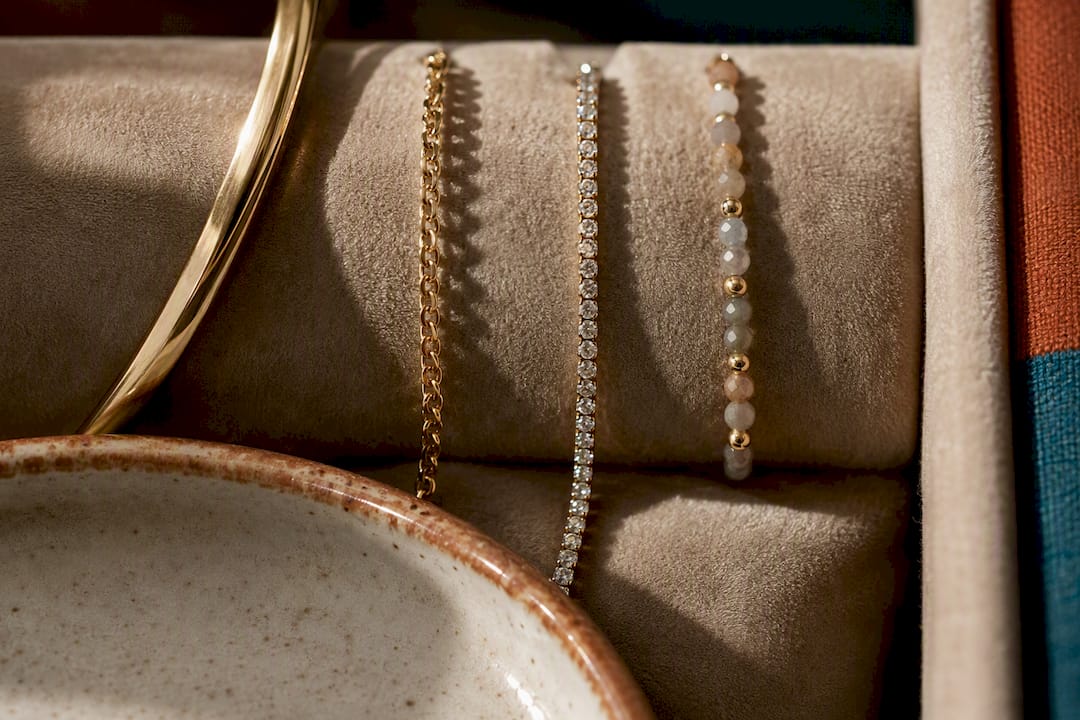
A tennis bracelet often makes an ideal anchor. Its continuous line of stones reads as substantial without the bulk of a wide cuff, and it pairs cleanly with both delicate chains and heavier cuffs. Beaded bracelets and small charm pieces function purely as accents. Limit them to one or two per stack, since piling on several at once adds visual clutter fast.
If you wear a watch, treat it as part of the count. Build your stack on the opposite wrist, or keep the same wrist to two slim pieces max so nothing competes with the watch face.
How Do You Measure Bangles and Bracelets for a Comfortable Stack?
Fit problems ruin more stacks than bad styling choices do. A bracelet that slides constantly or one that pinches will get left in a drawer no matter how good it looks on paper.
- Measure the inner diameter of a bangle you already own that fits well, or wrap a soft tape around the widest part of your hand where it needs to pass over your knuckles.
- Compare that number against a bangle-size chart rather than guessing between small, medium, and large.
- For closed bangles with no opening, size up slightly since they need to clear your knuckles before settling at the wrist. This is the two-finger rule in practice: you should be able to slip two fingers under the bangle once it is on.
- When stacking several bangles together, size them consistently so they slide over the hand as a set rather than jamming one at a time.
- If pieces keep sliding down and bunching, add a snugger anchor bracelet or leave a small gap between bangles so friction holds them in place.
Three Starter Stacks You Can Copy Today
Instead of starting from scratch, borrow one of these combinations and adjust to your own pieces.
- Everyday stack. A slim chain, a thin bangle, and one small beaded accent. Keep all three light in weight and let the beaded piece sit loosest, since two to three pieces works well for daily wear without feeling heavy on your arm.
- Work stack. A close-fitting tennis bracelet or sleek bangle paired with one thin chain. Keep the profile low so nothing catches on a keyboard or sleeve, and stick to one metal tone for a boardroom-appropriate look.
- Special occasion stack. A statement cuff as the anchor, a tennis bracelet layered just inside it, and one pavé or charm piece for shine. Leave slightly more space between each piece here so the detail on every bracelet actually catches light.
Each recipe names its anchor first, then fills in supporting pieces by role rather than by whatever happens to be closest in your jewelry box.
How Do You Keep a Bracelet Stack Looking Good All Day?
Material choice decides how well a stack survives daily wear. Solid gold and sterling silver resist scratching better over years of wear, while gold-plated pieces need gentler handling to avoid rubbing off the finish, especially where two bracelets touch and grind against each other.
- Check clasps before you leave the house. A loose clasp is how bracelets end up lost, not stolen.
- Wipe pieces down with a soft cloth at the end of the day to remove oils and residue.
- Store bracelets flat or hung separately rather than tangled in one dish, which causes scratching between pieces.
- Remove your full stack before swimming, heavy exercise, or sleep, since moisture and friction wear down plating fastest.
Pro Tip: Keep one delicate, high-shine piece out of the daily rotation entirely and save it for occasions. It stays looking new far longer than one worn every single day.
How Trinity Carter Pieces Fit Into a Stack
Trinity Carter’s collection maps cleanly onto the anchor, structure, and accent roles a good stack needs. The Essential V Bracelet works well as an anchor thanks to its clean line and scale, while a piece like the X Cross Cable Bracelet supplies structure with its twisted cable design and bold motif. Smaller gold-plated chains and charm pieces round out the accents.
One combination that works reliably: the Essential V Bracelet as anchor, the X Cross Cable Bracelet for structure, and one slim gold-plated chain closest to the hand. For more on building around a defined centerpiece, Trinity Carter’s Essential V Bracelet style guide walks through the same anchor logic in more detail.
A Personal Note on Building Your Own Stack
Try one new metal or texture combination a month instead of overhauling your whole jewelry box at once. Jewelry works best as personal shorthand, not a uniform, and the stacks that actually get worn are the ones built slowly around pieces you already reach for. Certain jewellery collections provide a solid place to test one new anchor or accent when you’re ready.
— Trinity
Where to Shop for Stackable Bracelet Pieces
Building a stack gets much easier once you’re choosing from pieces designed to layer in the first place, rather than forcing mismatched bracelets together. Trinity Carter’s bracelets collection is organized around exactly that: anchor pieces with enough presence to lead a stack, structured pieces like the X Cross Cable Bracelet to add contrast, and slimmer gold-plated accents to fill in the gaps.

If you’re unsure where to start, try two-tone pieces first since they bridge metal tones without any guesswork, and check sizing before buying anything meant to sit close to the wrist. The Essential V Bracelet is a practical first anchor purchase if you’re building a stack from nothing. Browse the full bracelets collection and pick one anchor piece to start building around this week.
Sources
- How to Stack Bracelets: 11 Bracelet Stack Ideas and Tips
- How to Measure Your Hand or Bangle Size – Find Your Perfect Fit – Banglez
- How to Stack Bracelets: Expert Styling Tips | Sylvie Jewelry
- Bracelet — Wikipedia
