

Mixing metals in jewelry is not a fashion risk. It’s one of the fastest ways to make a jewelry box look current, and pros agree it works as long as you follow a simple organizing rule: pick a dominant metal, repeat your accent color at least once, and use a two-tone “bridge” piece to connect them. Everything else in this guide builds on that one rule.
TL;DR:
- A dominant metal serves as a visual anchor, with balanced ratios and repeated accents creating a cohesive mixed-metal look.
- Bridge pieces, such as two-tone necklaces or rings, are essential for connecting metals and making a deliberate styling statement.
- Distributing metals across different jewelry types and varying texture and silhouette enhances the intentionality of the outfit.
- Careful identification of metals through stamps, color, and weight helps prevent skin reactions and guides appropriate maintenance.
- Currently, trending styles include two-tone stacking, mismatched earrings, and layered necklaces, which reflect a return to traditional mixing practices.
Table of Contents
- Three Quick Rules To Check Before You Step Out
- Core Styling Principles That Make Mixed Metals Look Intentional
- How To Mix Metals By Jewelry Type
- Starter Looks You Can Copy Right Now
- What Mixed-Metal Jewelry Is Made Of (And How To Care For It)
- Trinity Carter’s Take On Building A Mixed-Metal Collection
- Where Mixing Metals Actually Comes From
- How To Tell Your Metals Apart Before You Mix Them
- Avoiding Skin Reactions When You Mix Metals
- What’s Trending In Mixed Metals Right Now
- Mixing Metals For Different Occasions And Styles
- Trinity’s Take: Why Mixing Metals Fits Everyday Elegance
- Shop The Pieces That Make Mixing Metals Easy
- Sources
Three Quick Rules To Check Before You Step Out
Before you leave the house, run your jewelry through a fast three-point check. It takes less time than picking shoes.
1. Pick your ratio. Most stylists suggest a split favoring one metal as dominant with the other as an accent. Some looks use a closer to equal split, which can look bolder and works well when both metals carry similar weight and finish.
2. Repeat the accent at least once. A single silver ring against an all-gold outfit looks like a mistake. A silver ring plus a silver charm on your bracelet stack looks deliberate. The repetition is what separates “oops” from “on purpose.”
3. Use a bridge piece. A two-tone necklace, ring, or bracelet that physically combines both metals in one item does the visual translation work for you. It’s the single easiest trick in mixed-metal styling, according to pros interviewed by The Cut.
From there, a few finer points round out the checklist:
- Distribute your metals across your neck, ears, wrists, and fingers instead of clustering one tone in a single spot, a distribution habit MasterClass styling guidance calls out specifically.
- Balance a chunky piece in one metal with something delicate in the other so neither fights for attention.
- Vary silhouette between your dominant and accent pieces (a sharp geometric ring next to a soft, rounded bangle) rather than matching everything by color alone.
Run through those three checks and you’re ready. The sections below explain why each one works and how to apply it by jewelry type.
Core Styling Principles That Make Mixed Metals Look Intentional
Here’s what’s actually happening when a mixed-metal outfit reads as “put together” instead of “grabbed whatever was on the dresser.”
**1. Filigree Jewelers frames this as a practical ratio framework precisely because it removes the guesswork. A dominant metal approach gives the whole look a visual anchor, which keeps it from reading as accidental.
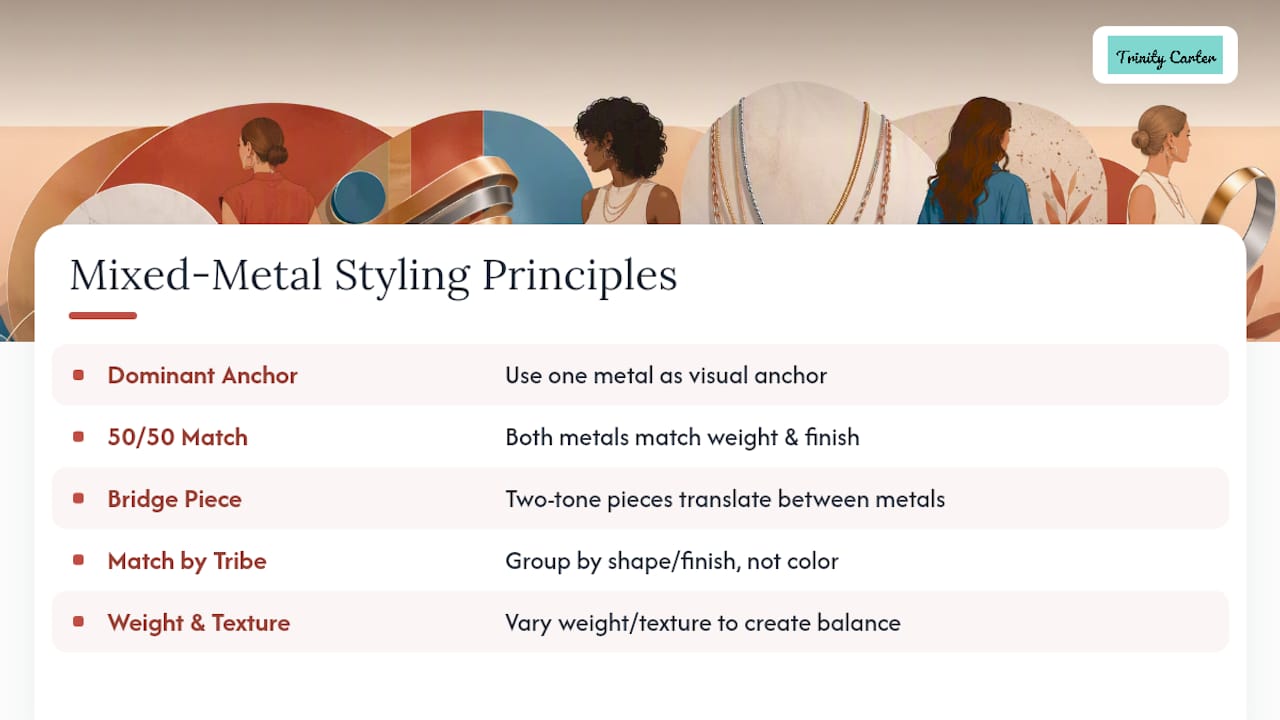
2. The 50/50 split works, but only under specific conditions. If you’re going closer to even, both metals need to match in weight and finish. Two delicate chains, one gold and one silver, at roughly equal presence, can look striking. Two wildly different weights at 50/50 usually just looks unresolved.
3. Bridge pieces do the heavy lifting. David Yurman’s styling guidance recommends a two-tone anchor piece, repeated motifs, and varied texture as the core toolkit for harmonizing tones. A two-tone bracelet, a ring with a gold band and silver stone setting, or a necklace with alternating links all function the same way: they sit between your two metals and make the jump between them feel planned. Two-tone pieces work as translation layers, which makes them the lowest-risk entry point if you’ve never mixed metals before.
4. Match by “tribe,” not by color. Stylists often group pieces by shape and finish instead of tone. Geometric, hard-edged pieces pair with other geometric pieces regardless of metal. Organic, curved shapes pair with other organic shapes. A boxy gold cuff and a boxy silver cuff share a design language even though they don’t share a color.
5. Weight and texture create balance faster than color-matching does. A chunky gold chain paired with a fine silver bracelet reads as styled contrast. Two chunky pieces in different metals tend to compete. Varying weight and texture between metals helps the mix look like a design choice rather than a mismatch.
Pro Tip: If you’re not sure how many metals to wear, cap yourself at two for daily wear and save a third metal (like rose gold as a subtle accent) for occasions where you have more time to plan the full look.
One last principle worth naming: limit yourself to two dominant tones per outfit unless you’re deliberately going for a maximalist, stacked-jewelry moment. Three or more competing metals, without a bridge piece to organize them, is where most mixed-metal outfits fall apart.
How To Mix Metals By Jewelry Type
The rules above play out differently depending on what you’re actually wearing. Here’s how to apply them category by category.
Necklaces. Vary your chain lengths when layering, and alternate metals between lengths rather than clustering all one tone at the collarbone and all of the other lower down. A short gold choker, a mid-length silver pendant, and a long gold chain reads as a deliberate stack. If you want a true bridge piece, a pendant necklace with mixed-metal detailing at the center point can anchor the whole layered look, and layering guidance from Trinity Carter covers spacing between lengths in more detail.
Rings. Stack alternately rather than grouping identical metals on one finger and the other metal on a different hand. Pick one ring to act as your anchor (usually the boldest or most detailed piece) and let the rest support it. Ring stacking guidance walks through how to build a stack that doesn’t compete with itself, and a closer look at seasonal stacking approaches covers how to adjust the mix for different occasions.
Bracelets. Alternate bangles by metal and vary their thickness so your wrist doesn’t read as one flat block of gold or silver. If you’re wearing a watch, treat it as your anchor piece and build the rest of your stack to complement its metal, adding your accent tone only once or twice more. Bracelet stacking ideas show a few ways to layer thickness and tone together.
Earrings. You have two solid options here. Coordinate a mismatched pair (one stud in gold, one in silver) for a deliberately asymmetric look, or repeat the same shape in two different metals across your ear if you’re wearing multiple piercings. Everyday stud styling covers coordinating shapes across mixed metals in more detail.
Watches. A watch case is usually your most visible, hardest-to-swap metal tone, so build everything else around it instead of fighting it. If your watch is gold, let gold dominate your bracelet stack and bring in silver only as a repeated accent.
Starter Looks You Can Copy Right Now
You don’t need to overthink your first mixed-metal outfit. Start with one of these four combinations and adjust from there.
1. Minimal everyday. One dominant metal (say, gold studs and a gold ring), one accent piece in silver (a thin bracelet), and a two-tone bridge necklace connecting them. This is the lowest-effort, lowest-risk way to start mixing metals for the first time.
2. Office-ready. A balanced ring stack that alternates gold and silver bands, paired with a single two-tone necklace as the focal point of the outfit. Keep earrings simple and in your dominant metal so the necklace stays the star.
3. Evening. Vary texture and scale more aggressively (a chunky gold cuff, delicate silver drop earrings) while still keeping one metal dominant overall. Evening looks can handle more contrast because the setting already reads as intentional.
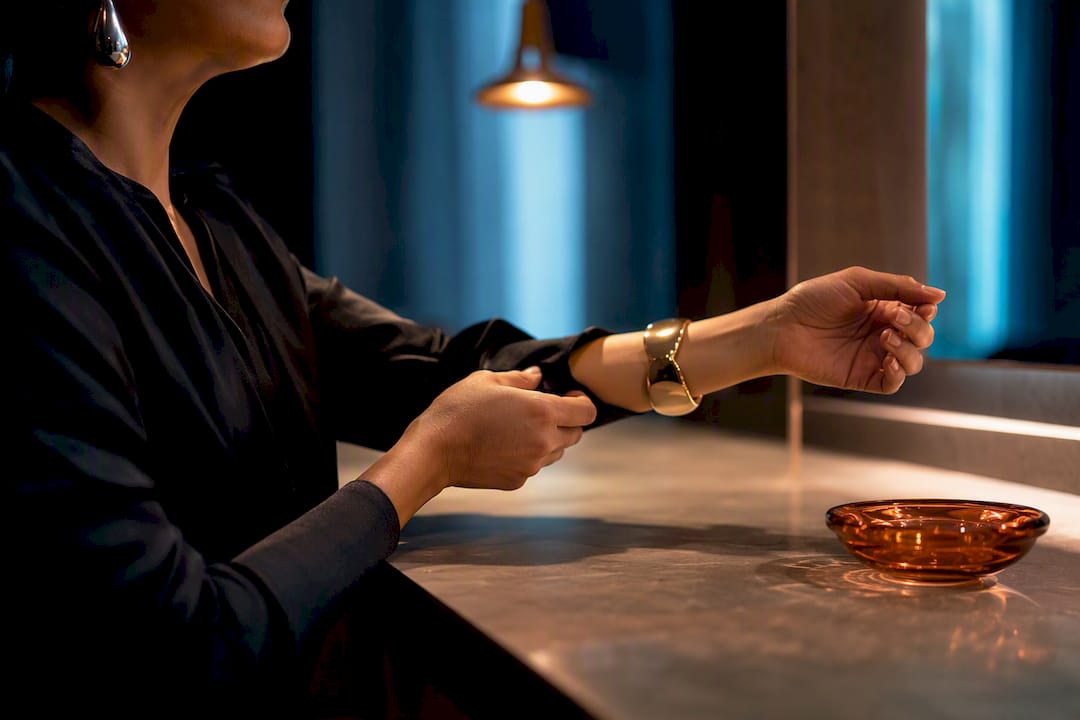
4. Mismatched earrings. Choose this trend option when you want a single, low-commitment way to signal that your mixed-metal styling is deliberate rather than accidental. It works especially well with a minimal outfit that has no other competing jewelry.
Mixed-metal styling has moved well past “trend” status. Runway looks and platforms like Pinterest have pushed the style into everyday normal territory, which is part of why it now shows up in office-appropriate jewelry guides, not just editorial spreads.
What Mixed-Metal Jewelry Is Made Of (And How To Care For It)
Before you build a mixed-metal collection, it helps to know what you’re actually buying. Sterling silver is 92.5% silver mixed with other metals for durability. Yellow, rose, and white gold vary by their alloy mix, with rose gold getting its color from added copper. Gold vermeil is sterling silver with a thick layer of gold plating over it, while gold-plated pieces use a base metal core (often brass) with a thinner gold layer on top. Two-tone pieces combine two of these finishes in one item, usually through a bonding or plating process that fuses them permanently, which is exactly what makes them effective bridge pieces.
Care differs by finish:
- Store pieces separately or in soft pouches to avoid scratching plated surfaces.
- Remove jewelry before swimming, showering, or applying lotion, since moisture accelerates plating wear.
- White gold needs occasional rhodium replating to keep its bright white finish, and plated pieces in general show wear over time, meaning they typically need replating or replacement more often than solid metal.
- Wipe pieces with a soft cloth after wear to remove oils and residue before storing.
A closer breakdown of plated versus vermeil finishes covers which option holds up better for daily wear versus occasional pieces.
Trinity Carter’s Take On Building A Mixed-Metal Collection
Some gold-plated pieces are designed to work comfortably as either the dominant metal or the accent, which is exactly the flexibility a mixed-metal wardrobe needs. A few resources worth bookmarking as you build your own rotation:
- Plated versus vermeil guidance for understanding what you’re buying and how it wears
- Designer-inspired styling philosophy behind how Trinity Carter approaches everyday elegance
Where Mixing Metals Actually Comes From
Mixing metals in jewelry isn’t a new idea invented by Instagram stylists. Ancient Egyptian jewelry regularly combined gold with silver and semi-precious stones, and Byzantine craftsmen mixed gold and silver in the same pieces centuries before “mixed metals” became a marketing phrase. What changed over the 20th century wasn’t the technique, it was the rule.
For most of the mid-1900s, Western fashion etiquette treated metal-matching as a hard requirement: your watch, rings, and earrings were supposed to share one tone, full stop. That rule loosened considerably by the 1990s and 2000s as fashion moved toward personal expression over formal matching, and it collapsed almost entirely once street-style photography and social media started rewarding individuality over uniformity.
Different cultures never fully bought into the matching rule in the first place. Indian bridal jewelry has long combined gold with silver-toned accents and gemstone settings in a single piece. West African goldsmithing traditions often layer tones and textures within one design rather than keeping metals separate. What Western fashion now treats as a trend, several jewelry traditions treated as standard practice for generations. The current mixed-metal movement is less an invention and more a return to how jewelry was made before 20th-century matching rules narrowed the options.
How To Tell Your Metals Apart Before You Mix Them
You can’t mix metals confidently if you can’t identify what you’re holding. Here’s the fast way to sort your collection.
Check for a stamp first. Most genuine gold pieces are stamped with a karat marking like 14K, 18K, or 10K, which tells you the gold purity (24K is pure gold; 14K is about 58% gold mixed with other metals). Sterling silver is typically stamped “.925.” Platinum pieces are often marked “PLAT” or “950.” No stamp usually means plated or base metal, not necessarily a red flag, just useful information for pricing and care.
Look at the color undertone. Yellow gold has a warm, buttery tone. Rose gold leans pink or peach from its copper content. White gold and platinum both look silvery, but platinum has a slightly grayer, denser look while white gold can carry a faint yellow undertone once its rhodium plating wears down.
Weight is a clue, not proof. Platinum is noticeably heavier than white gold or silver of the same size, which is one reason platinum pieces often cost more even at similar-looking designs. This isn’t a reliable at-home test on its own, but combined with a stamp check, it helps confirm what you’re working with.
When in doubt, treat unmarked pieces as costume or plated. For mixing purposes, this doesn’t matter much. Whether a piece is solid gold or gold-plated, it still functions as your “gold” for styling purposes. The identification matters more for care and cost expectations than for the mixing rules themselves.
Avoiding Skin Reactions When You Mix Metals
Mixing metals means wearing more pieces at once, and more pieces means more chances to react to a metal your skin doesn’t tolerate well. Nickel is the most common trigger for jewelry-related skin reactions, and it often shows up in base-metal cores under cheap plating or in some white gold alloys.
A few practical habits lower your risk without limiting your styling options. Choose hypoallergenic bases like sterling silver, solid gold, titanium, or surgical steel for pieces that touch your skin directly and for long wear, especially earrings and rings you keep on all day. Reserve heavily plated or base-metal costume pieces for shorter wear, like an evening out, rather than daily rotation. If a piece starts to itch, turns your skin green, or leaves a rash, stop wearing it and switch to a hypoallergenic version of that same tone instead of abandoning the metal color altogether.
Layering multiple pieces against the same patch of skin (a stacked bracelet arm, for instance) also increases moisture and friction, which can worsen a reaction that a single piece wouldn’t cause. If you know you’re nickel-sensitive, that’s the spot to be most selective about material quality. A closer look at jewelry options for sensitive skin covers which finishes tend to cause the fewest issues.
What’s Trending In Mixed Metals Right Now
Two-tone stacking dominates current mixed-metal trends, particularly rings and bracelets that combine gold and silver in a single continuous piece rather than as separate items worn together. This ties directly back to the bridge-piece principle. Brands are building the mixing decision into the product itself instead of leaving it to the wearer.
Mismatched earrings remain one of the most visible trend expressions, especially paired with multiple piercings where each ear tells a slightly different metal story. Chain-link bracelets that combine chunky gold links with finer silver detailing have also grown popular, reflecting the weight-and-texture balancing principle in a single wearable piece.
Rose gold has settled in as a semi-permanent third option rather than a passing trend, often used as a subtle accent against a gold-and-silver base rather than as its own dominant tone. And layered necklace sets sold as pre-styled bridge collections, multiple lengths and tones packaged together, have become a common way for brands to make mixed-metal styling approachable for someone who doesn’t want to build the look piece by piece.
Mixing Metals For Different Occasions And Styles
The dominant-metal rule flexes depending on where you’re headed and what your closet already leans toward.
Minimalist or capsule wardrobes benefit most from the tightest version of the 70/30 rule: one dominant metal worn consistently, one accent repeated in just one or two pieces, and a single bridge item doing the connecting work. This keeps a small jewelry collection feeling cohesive across outfits.
Boho or eclectic styles can push toward 50/50 or even a third metal, since the aesthetic already embraces visual layering and texture contrast. Chunky, textured pieces in mixed tones fit naturally here.
Business or office settings call for restraint. Stick to the 70/30 ratio, limit yourself to two metals, and let a single two-tone piece (a watch, a ring, or a necklace) carry the mixed-metal statement while everything else stays simple.
Formal or evening occasions are where you can loosen the ratio slightly and lean into scale and texture contrast, since the setting already signals intentional styling. A bolder accent presence reads as glamorous rather than careless.
Bridal and special-occasion jewelry often benefits from a two-tone anchor piece from the start, since it makes coordinating with a partner’s jewelry, family heirlooms, or gifted pieces in a different metal far simpler down the line.
Trinity’s Take: Why Mixing Metals Fits Everyday Elegance
Matching every piece to a single metal always felt like a rule made for someone else’s closet. Trinity Carter designs around the idea that gold-plated pieces should work as both the star and the supporting act, which is exactly what mixing metals demands. Start with one bridge piece, wear it for a week, and notice how much more you reach for your other jewelry once it has a role to play instead of sitting in a drawer waiting for a matching outfit.
— Trinity
Shop The Pieces That Make Mixing Metals Easy
Some brands offer gold-plated pieces designed to work as your dominant metal on a simple day and as a bridge or accent piece when you’re layering something bolder.
The Essential V Bracelet is a strong anchor piece for a bracelet stack, simple enough to dominate a minimal look but versatile enough to sit alongside a silver accent piece without competing. The Essential V Necklace Pendant works the same way for necklace layering, a clean bridge point between longer and shorter chains. If you’re building a ring stack, the Blossom Flowergram Ring adds a floral, organic detail that pairs well against a more geometric silver piece using the “tribe” matching principle covered earlier.
Browse the full ring collection or necklace collection to find your own anchor piece, or start with the bracelet collection if wrist stacking is where you want to experiment first.
Sources
- How to Mix Metal Jewelry, According to Pros
- How to Mix Metal Jewelry: 6 Tips for Mixing Metals - MasterClass
- How to Style Mixed Metal Jewelry | David Yurman
- How to Mix Metals in Jewelry: The Complete Guide - Filigree Jewelers
