

For everyday sparkle and long-term wear, moissanite wins. For trend-driven, seasonal pieces you plan to rotate or replace, cubic zirconia is the smarter spend. That’s the short answer. Moissanite scores 9.25 on the Mohs hardness scale versus CZ’s 8–8.5, and its refractive index of 2.65–2.69 produces noticeably stronger fire. CZ costs a fraction of the price and looks stunning out of the box, but it dulls with daily exposure to soaps and lotions in ways moissanite simply doesn’t. For Trinitycarter’s gold-plated, designer-inspired pieces, the right choice depends on how often you wear it and how long you want it to last.
Table of Contents
- How does moissanite vs cubic zirconia actually compare?
- How do these stones actually look in gold-plated designer settings?
- Which stone holds up better over time?
- What do moissanite and CZ actually cost, and what do you get?
- Which stone fits Trinity Carter–style gold-plated pieces best?
- How to clean and care for moissanite and CZ pieces
- How to tell moissanite from CZ when you’re shopping
- What’s the final verdict for affordable-luxury shoppers?
- Key Takeaways
- Why lab-created stones are the right call for affordable-luxury buyers
- Trinitycarter’s crystal collections: where to start
- Useful sources and further reading
How does moissanite vs cubic zirconia actually compare?
| Dimension | Moissanite | Cubic Zirconia |
|---|---|---|
| Price per carat | moderate (hundreds of dollars) | low (tens of dollars) |
| Mohs hardness | 9.25 | 8–8.5 |
| Refractive index | 2.65–2.69 | 2.15–2.18 |
| Dispersion (fire) | ~0.104 | ~0.058–0.066 |
| Longevity | Decades with care | A few years for high-grade stones |
| Maintenance | Low | Frequent, gentle cleaning |
| Best use | Daily wear, heirloom pieces | Fashion, seasonal, occasional |
| Ethical origin | Lab-created | Lab-created |
Three tradeoffs matter most here. First, moissanite costs significantly more upfront but holds its appearance far longer, making the per-year cost competitive. Second, moissanite’s fire is vivid and rainbow-like; CZ’s sparkle is whiter and softer, closer to a diamond’s look. Third, CZ needs more attentive care to stay brilliant, especially in gold-plated settings where cleaning frequency also affects the plating itself.
How do these stones actually look in gold-plated designer settings?
Moissanite’s higher brilliance is the headline, but the character of that light is what you’ll actually notice. Its refractive index of 2.65–2.69 and dispersion of ~0.104 produce intense rainbow flashes, especially in direct sunlight or under warm indoor lighting. Some love that effect. Others find it a touch bold for minimalist styling.
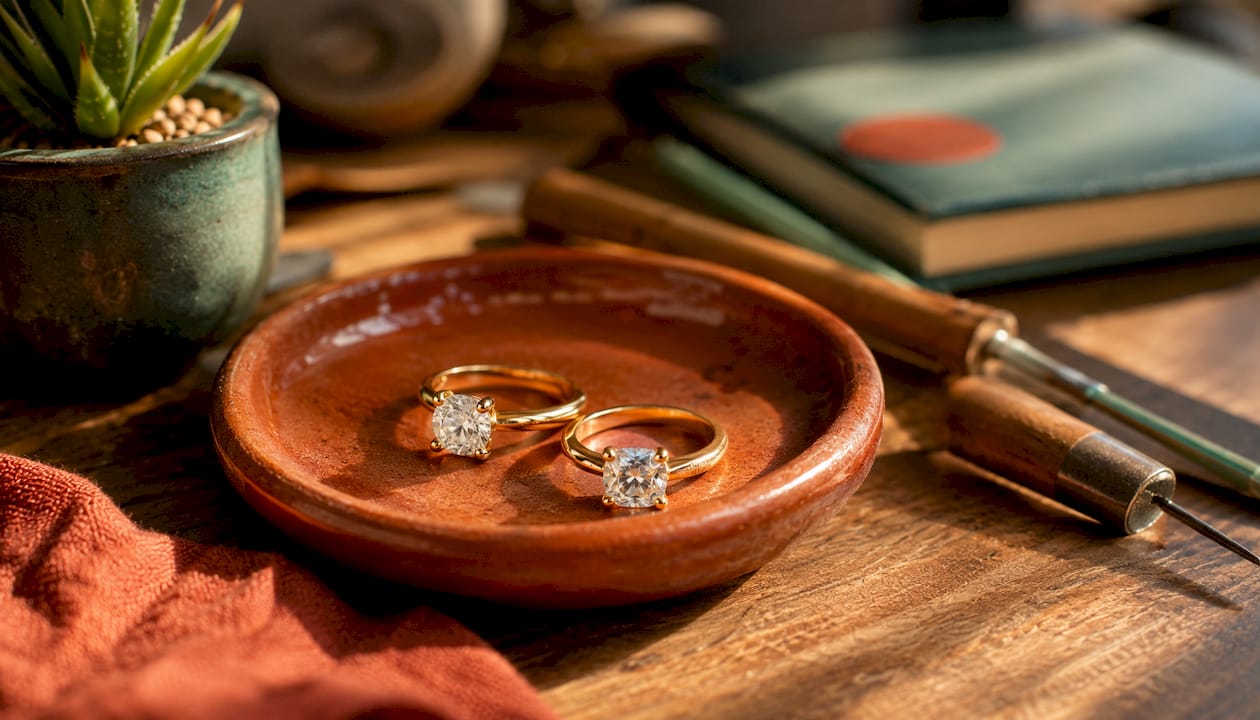
CZ sits at a refractive index of 2.15–2.18 and dispersion of 0.058–0.066, which gives it a cleaner, whiter sparkle. Against gold plating, that cooler white light creates a crisp contrast that reads as classic and polished. Moissanite’s warmer fire can blend beautifully with yellow gold tones, adding depth to floral motifs and layered crystal inlays.
For Trinitycarter’s three-row crystal bands and adjustable bracelets, CZ’s softer sparkle photographs cleanly and suits trend-led styling. Moissanite, with its stronger fire, elevates pieces meant to be worn as a signature, not rotated seasonally.
Pro Tip: When photographing gold-plated jewelry for social media, CZ’s whiter sparkle tends to read more clearly in natural light, while moissanite’s rainbow fire shows best under warm indoor lighting.
Which stone holds up better over time?
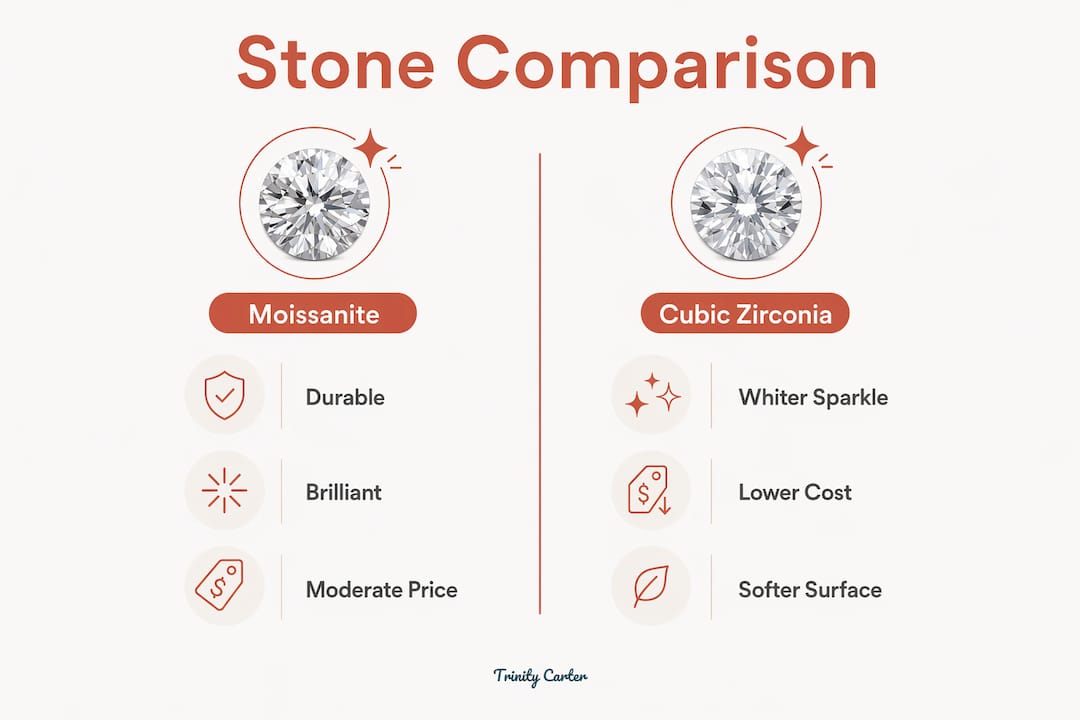
Moissanite is substantially more durable for daily wear. At Mohs 9.25, it resists scratching from virtually all everyday contact. CZ at 8–8.5 is still reasonably hard, but micro-scratches accumulate faster, and its surface porosity means oils, soaps, and lotions get trapped in those micro-abrasions over time.
| Property | Moissanite | Cubic Zirconia |
|---|---|---|
| Mohs hardness | 9.25 | 8–8.5 |
| Density | Lower | Higher than diamond |
| Clouding risk | Minimal | Moderate to high with daily wear |
| Lifespan (with care) | Decades | A few years for high-grade stones |
That clouding isn’t a manufacturing defect. Gemologists note that CZ’s dulling is a predictable physical result of its porosity and surface abrasions from daily chemical exposure, not a sign of poor quality at the time of purchase. Regular, gentle cleaning slows the process but doesn’t stop it entirely.
Pro Tip: If your CZ piece starts looking hazy, a professional repolish can restore some brilliance. But if the stone has deep micro-scratches, replacement is often more cost-effective than repolishing, especially since CZ stones are inexpensive to source.
What do moissanite and CZ actually cost, and what do you get?
Moissanite runs roughly several hundred dollars per carat for high-quality colorless stones. High-grade CZ typically costs a few tens of dollars per carat. That gap is real, but so is the difference in how long each stone performs.
A few things worth knowing before you buy:
- Replacement cost vs. longevity: CZ is cheap to replace, which matters if you treat jewelry as seasonal. Moissanite’s higher upfront cost spreads across years of wear.
- Resale value: Neither stone holds meaningful resale value. Moissanite has a limited secondary market due to low replacement cost; CZ has essentially none.
- Certification: Moissanite can come with gemological verification (IGI or GRA grading is common in the market). CZ relies on manufacturer grading systems like “5A” or “AAAA” without independent lab certification. Those grades are useful as a quality signal within a brand’s own range, but they’re not standardized across sellers.
For affordable-luxury pieces that you want to keep and wear repeatedly, moissanite’s cost-per-wear math works in its favor. For pieces you’re buying to match a specific season or trend, CZ’s price point makes more sense.
Which stone fits Trinity Carter–style gold-plated pieces best?
The answer depends on how you shop. If you’re building a small collection of pieces you’ll wear constantly, moissanite is the better investment. It pairs well with heirloom-style designs like multi-row rings and structured bracelets where the stone is a focal point and daily contact is expected.
CZ is the right call for trend-led, seasonal pieces. Trinitycarter’s adjustable crystal bracelets and motif rings are designed to be styled and rotated, which is exactly the use case where CZ’s lower price point makes sense. You can refresh your look without the cost commitment of moissanite.
One practical note: gold plating has its own lifecycle, typically requiring replating every 1–2 years with regular wear. CZ’s 2–5 year lifespan with careful maintenance aligns reasonably well with that replating cycle, meaning you may be refreshing both the stone and the plating on a similar schedule anyway.
Pro Tip: For adjustable or moving-crystal pieces like sliding bracelets, CZ is a practical choice. The stone experiences more friction in these settings, and CZ’s lower cost makes replacement less painful if the stone dulls faster than expected.
How to clean and care for moissanite and CZ pieces
Both stones survive careful cleaning. CZ just needs it more often and responds badly to harsh handling.
- Rinse first. Hold the piece under lukewarm water to loosen surface oils before applying any cleaner.
- Use mild dish soap. A drop of gentle dish soap on a soft-bristle toothbrush works for both stones. Scrub lightly around the setting.
- Rinse thoroughly. Soap residue left in the setting accelerates CZ clouding.
- Pat dry with a lint-free cloth. Air drying leaves water spots, especially on gold plating.
- Store separately. Both stones can scratch softer metals and each other. Individual pouches or a lined jewelry box prevents contact damage.
Avoid chlorinated water (pools, hot tubs), hand lotions applied while wearing the piece, ultrasonic cleaners for CZ in prong settings (the vibration can loosen stones), and perfume sprayed directly onto the jewelry. These accelerate surface degradation on CZ and can lift gold plating.
Pro Tip: Time your deep clean to coincide with replating appointments. A freshly cleaned stone in freshly plated gold looks dramatically better than either element refreshed alone.
How to tell moissanite from CZ when you’re shopping
The quickest test is the fire test. Hold the stone under a light source and look for rainbow flashes. Moissanite produces vivid, colored light dispersion. CZ gives off a whiter, more uniform sparkle. In direct sunlight, the difference is obvious.
A few other practical checks:
- Fog test: Breathe on the stone. Moissanite clears almost instantly due to its thermal conductivity. CZ stays fogged slightly longer.
- Double refraction: Under magnification, moissanite shows doubled facet edges (it’s doubly refractive). CZ does not. A jeweler’s loupe makes this visible.
- Size vs. weight: CZ is denser than moissanite, so a 1-carat CZ will be physically smaller than a 1-carat moissanite. Always compare millimeter dimensions, not carat weight alone.
- Grading language: Vague labels like “AAAA” or “premium grade” without third-party verification are manufacturer grades, not independent certifications. Ask specifically whether moissanite comes with IGI or GRA documentation.
What’s the final verdict for affordable-luxury shoppers?
Moissanite for daily wear and pieces you plan to keep. CZ for seasonal, trend-driven, or lower-cost additions to your rotation. That’s the decision in one sentence.
Before you buy, run through this checklist:
- Stone dimensions in mm: Compare size, not carat weight, especially for CZ.
- Grading documentation: Ask for IGI or GRA certification on moissanite; understand that CZ grades are manufacturer-specific.
- Plating thickness: For gold-plated pieces, ask about micron thickness and expected replating frequency.
- Wear frequency: Daily wear favors moissanite; occasional or seasonal wear makes CZ’s price point sensible.
- Return policy: Confirm the return window before purchasing, especially for online orders.
Pro Tip: If you’re trying Trinitycarter’s crystal collections for the first time, a CZ bracelet or ring is a low-risk way to test a style before committing to a moissanite version of a similar design.
Key Takeaways
Moissanite outlasts CZ in daily wear because its Mohs hardness of 9.25 and non-porous surface resist the micro-abrasions and chemical dulling that degrade CZ over time.
| Point | Details |
|---|---|
| Hardness gap is real | Moissanite scores 9.25 on the Mohs scale; CZ scores 8–8.5, making CZ more prone to scratching. |
| Fire vs. white sparkle | Moissanite’s dispersion (~0.104) produces rainbow fire; CZ’s (0.058–0.066) gives a softer, whiter look. |
| CZ lifespan with care | High-grade CZ retains sparkle for 2–5 years; moissanite maintains brilliance for decades. |
| Both are lab-created | Neither stone requires mining, making both an ethical choice for sustainable jewelry shoppers. |
| Trinitycarter’s range | Trinitycarter uses CZ in trend-led gold-plated pieces suited to seasonal wear and affordable rotation. |
Why lab-created stones are the right call for affordable-luxury buyers
The conventional wisdom used to be that lab-created stones were a compromise, a budget concession dressed up as a choice. That framing is outdated. Lab-created stones like moissanite and CZ avoid the environmental and social costs of mined diamonds entirely, and they do it without sacrificing visual quality.
What’s actually underestimated here is how well this aligns with the designer-inspired jewelry model. The goal was never to replicate a mined stone. It was to deliver the aesthetic of luxury at a price point that makes sense for real life. CZ and moissanite both do that, just for different wear patterns and budgets. The choice between them isn’t about which is “better” in the abstract. It’s about matching the stone to how you actually live and style yourself.
Trinitycarter’s crystal collections: where to start
If the article’s buying advice points you toward CZ for seasonal, trend-forward pieces, Trinitycarter’s crystal collections are built exactly for that. The Crystal Love Bracelet features a sparkling CZ inlay in a gold-plated setting, designed for the kind of everyday elegance that doesn’t require a significant investment. The Triple Crystal Classique Ring brings a three-row crystal band to designer-inspired styling at an accessible price.
Both pieces come with Trinitycarter’s standard return policy, so first-time buyers can order with confidence. If you’re unsure about sizing, the product pages include detailed millimeter measurements, which matters more than carat weight when comparing crystal stones. Browse the full crystal range at trinitycarter.com to find the style that fits your rotation.
Useful sources and further reading
- International Gem Society: Cubic Zirconia vs Diamonds — authoritative overview of CZ composition, hardness, and durability expectations
- Aquamarise: Moissanite vs Cubic Zirconia — sourced hardness, refractive index, dispersion figures, and price ranges used throughout this article
- Charles & Colvard: Cubic Zirconia vs Moissanite — gemologist-informed explanation of CZ clouding mechanisms and moissanite durability
- CutGrade: Moissanite vs Diamond — detailed optical and resale value comparison
- Lukhi Diamond: Benefits of moissanite over natural diamonds — ethical sourcing and sustainability context for lab-created stones
A note on CZ grading: manufacturer grades like “5A” or “AAAA” reflect a seller’s internal quality standard, not an independent gemological assessment. They’re useful for comparing stones within a single brand’s range, but they don’t carry the same weight as IGI or GRA certification for moissanite. When shopping online, treat these grades as a starting point, not a guarantee.
