

Vary your chain lengths by about 2 inches, pick one pendant as the anchor, and stop at three necklaces for daily wear. That single move fixes most tangling and clutter problems. Mix textures and metals freely once the lengths are spaced right, and if you’re wearing four or more chains, a layering clasp or a mix of heavy and light weights keeps everything from spinning into a knot by lunchtime.
TL;DR:
- Keeping necklace lengths spaced by about 2 inches prevents tangling and creates a more cohesive layered look.
- Mixing chain shapes such as paperclip with cable or snake with curb enhances visual interest and avoids a rope-like appearance.
- Positioning a pendant on the middle chain and choosing its size proportionally to your neckline helps anchor the stack effectively.
- Using a layering clasp or small jump rings can significantly reduce twisting and tangling of three or more necklaces.
- For different occasions, adjust chain thickness and pendant size, with delicate chains for work and bolder pieces for casual or evening wear.
Table of Contents
- What Is the 2-Inch Rule for Necklace Layering?
- Which Chain Types Layer Best Together?
- How Do You Use a Pendant to Anchor a Stack?
- When Does Mixing Metals Actually Work?
- How Should You Layer Necklaces for Different Necklines?
- How Do You Keep Layered Necklaces From Tangling?
- What Are Some Easy Starter Stacks to Copy?
- How Do You Choose Necklaces for Your Style or Face Shape?
- How Do You Adjust Necklace Layering for Work, Casual Days, or Formal Events?
- How Do You Balance Necklaces With Earrings, Bracelets, and Rings?
- Trinity’s Take: Building Stacks That Actually Get Worn
- Ready-to-Layer Pieces From Trinity Carter
- Sources
What Is the 2-Inch Rule for Necklace Layering?
Space each necklace about 1 to 2 inches apart in length, and every chain gets its own lane on your chest instead of piling on top of the next one. This is the closest thing to a universal law in necklace layering, and it works because tangling happens when two chains sit at nearly identical lengths and start swinging into each other.
Common lengths break down like this:
- 14 to 16 inches: choker, sits right at the base of the neck
- 18 inches: princess length, the most common “everyday” necklace
- 20 inches: matinee, falls just below the collarbone
- 24 inches: opera length, lands at or below the bust
For a fast, no-math starting point, try 14 + 18 + 22 inches, or 16 + 18 + 24. Both formulas hit that 2-inch spacing without you needing a ruler. If you only own two pieces, even a rough gap (a 16-inch and a 20-inch) will read cleaner than two chains that are basically twins.
Which Chain Types Layer Best Together?
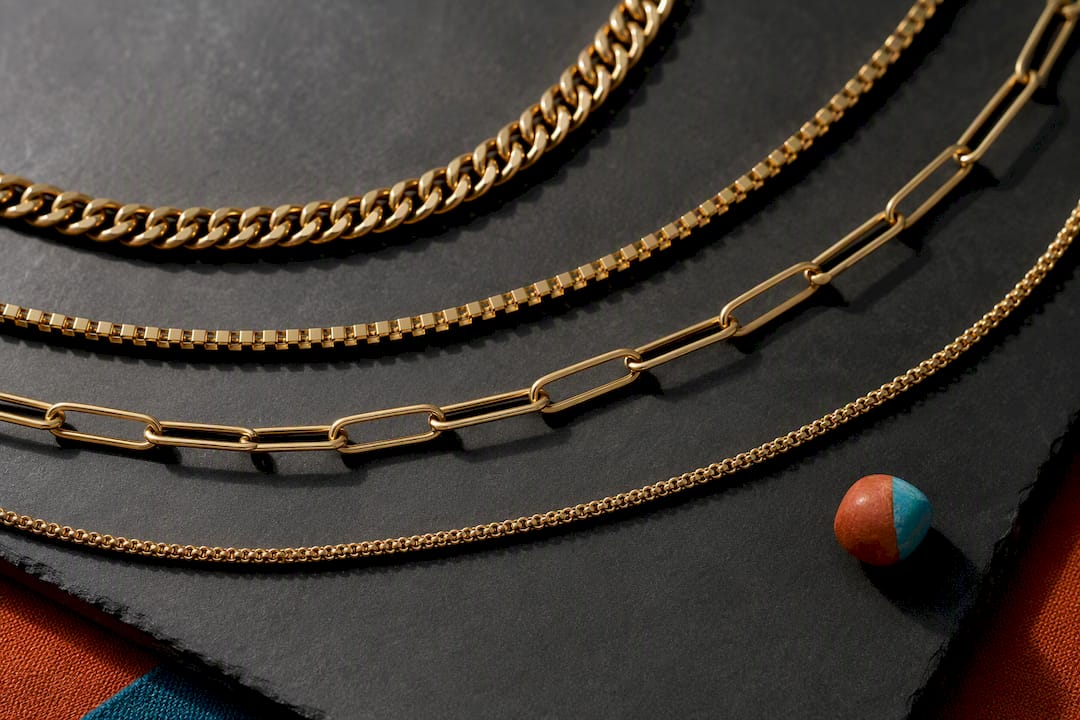
Chain silhouette matters as much as length. A stack of five nearly-identical cable chains just looks like one thick rope. Mixing shapes gives the eye something to track, and stylists consistently point to pairings like paperclip with cable, or snake with curb as reliable combinations.
A few reliable contrasts:
- Paperclip chain: flat, geometric links that photograph well against a thin cable chain
- Snake chain: smooth and fluid, reads as almost liquid next to a textured curb link
- Beaded chain: adds a soft, tactile break from anything polished or flat
- Curb chain: chunkier and structured, works best as the shortest layer
Order matters, too. A bolder, structured chain sits better closer to the neck, while finer, floppier chains fall longer underneath it.
Pro Tip: Structured chains (curb, box, paperclip) hold their position better than soft, floppy ones. If your stack keeps rotating, swap your shortest layer for something with more structure and it’ll anchor the rest.
How Do You Use a Pendant to Anchor a Stack?
A single, clear focal point gives your eye somewhere to land, which is why most stacks work better with one pendant than three competing charms. Anchoring the middle layer with a pendant is the move most stylists default to, since it draws attention without crowding the shorter chain above it.
Keep sizing proportional: a pendant roughly the width of two fingers works for most necklines, while anything wider starts competing with a low neckline instead of complementing it.
- Place your focal pendant on the middle chain, not the shortest or longest
- Scale the pendant to your neckline (smaller for high necklines, slightly bolder for open ones)
- If you’re stacking multiple small charms, group them on one length rather than spreading them across the whole stack
When Does Mixing Metals Actually Work?
Mixed metals read as intentional, not accidental, when there’s a repeated element tying the stack together. Editorial guidance now treats mixing gold and silver as an accepted trend, as long as you’re not just throwing pieces together at random.
The easiest fix is a two-tone piece, one necklace that has both gold and silver in its own design, worn alongside solid pieces of each metal. That single item acts like a translator between the two tones.
- Repeat a motif (two pendants with the same shape) in different metals
- Add one two-tone chain or clasp to visually connect the mix
- For plated gold pieces specifically, avoid extended contact with perfume, lotion, and pool or ocean water, since chlorine and salt water wear plating down faster than everyday air exposure
How Should You Layer Necklaces for Different Necklines?
Your neckline decides the shape of your stack more than your personal preference does. A V-neck wants a stack that echoes the V, while a crew neck needs length to avoid looking choked off.
- V-neck: Follow the line with a Y-shaped pendant or a graduated stack that points downward
- Crew neck: Go longer overall (18 to 24 inches) since shorter chains get swallowed by the fabric
- Button-down shirt: A choker sits above the collar while a mid-length piece falls inside the open placket
- Turtleneck: Skip anything short. Layer 20-inch-plus pieces on top of the fabric where they’ll actually show
Chain scale also signals formality. Delicate paperclip and cable chains in gold read as daytime and office-appropriate, while a chunkier curb chain or a bold pendant pushes the same stack toward evening.
How Do You Keep Layered Necklaces From Tangling?
Most tangling happens in the two seconds between taking necklaces off and tossing them in a drawer. Fix the routine, and the tangling mostly disappears.
- Put on your shortest necklace first, then add each longer piece on top, working outward
- Use a multi-chain layering clasp or small jump rings to link the backs of two or three chains together so they move as one unit instead of sliding independently
- Store each necklace separately, ideally hung rather than piled in a jewelry box, where clasps snag on other chains overnight
- Take plated pieces off before sleeping, showering, or swimming, since moisture and friction against sheets or pool chemicals accelerate wear on the plating
Dedicated layering clasps are worth the small investment once you’re running three or more chains at once, since they physically stop the “different speeds around the neck” problem that causes twisting.
Pro Tip: If you don’t own a layering clasp yet, a plain jump ring looped through two clasps at the back does almost the same job for the cost of a trip to any craft store.
What Are Some Easy Starter Stacks to Copy?
You don’t need six necklaces to look like you know what you’re doing. Two well-chosen pieces at the right lengths beat five random ones every time.
- Choker + 18-inch pendant: A simple 14 to 16-inch choker paired with an 18-inch chain holding a small pendant. Clean, works with almost any neckline.
- 16-inch delicate chain + 20-inch heavier chain: Pairs a fine cable chain with a bolder curb chain for contrast without needing a third piece.
- The 14/18/22 stack: A choker, a pendant necklace, and a longer plain chain, spaced exactly 4 inches apart for zero-tangle wear.
- The 16/18/24 stack: Similar idea, shifted slightly longer, which suits higher necklines like crew or turtleneck.
- Mixed-metal version: Take either three-piece formula and swap the middle chain for a two-tone piece to bridge a gold choker and a silver longer chain.
- Monochrome version: Same lengths, all gold-plated, varying only in chain type (paperclip, snake, curb) so texture does the visual work instead of color.
How Do You Choose Necklaces for Your Style or Face Shape?
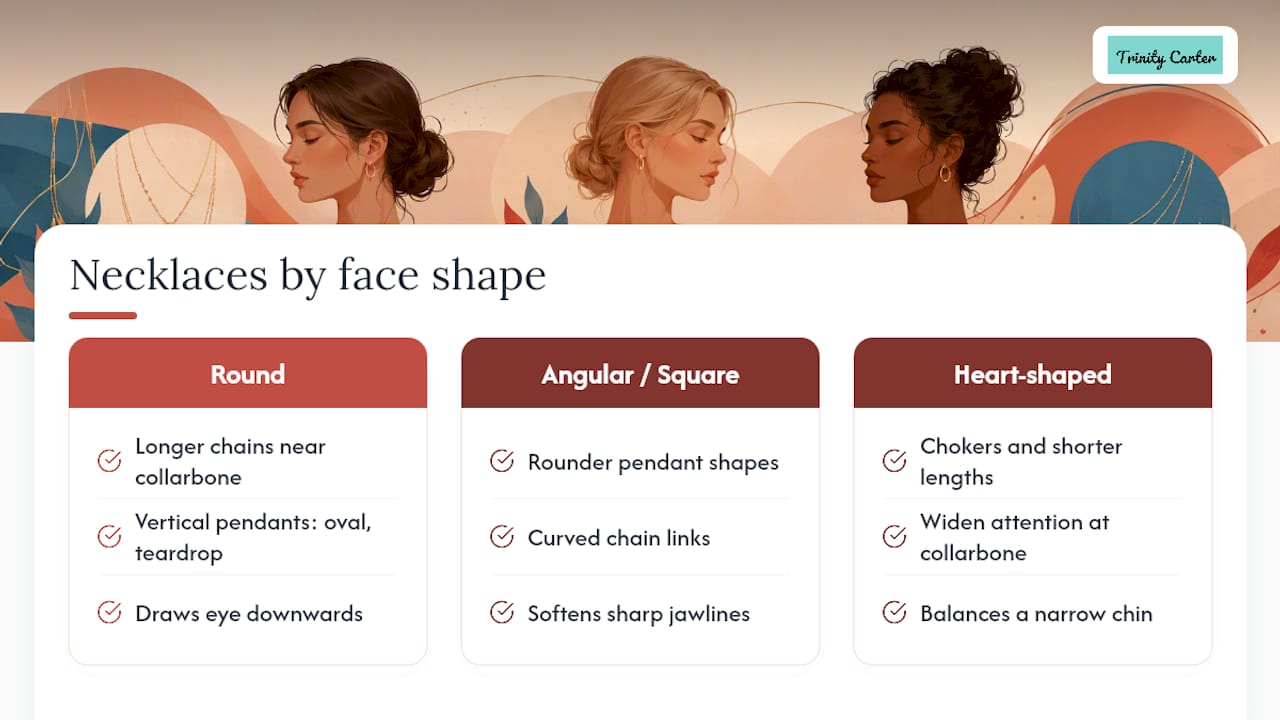
Face shape mostly affects pendant shape and chain length near the collarbone, not the whole stack. Rounder faces tend to benefit from longer, elongating chains and vertical pendant shapes (ovals, teardrops) that draw the eye down rather than across. Angular or square faces often look softened by rounder pendant shapes and curved chain links, since curves offset sharp jawlines. Heart-shaped faces generally do well with chokers and shorter lengths that widen visual attention at the collarbone, balancing a narrower chin.
Personal style matters just as much as face shape when you’re deciding where to start. If you gravitate toward minimalism, build your stack around one thin chain and one small pendant, then add a second chain only once that base feels finished rather than incomplete. If your taste runs more maximalist, you can support more pieces per stack (four or five), but you’ll lean on the 2-inch spacing rule even harder and probably want that layering clasp from the start.
Skin tone plays a smaller but real role too. Warmer, yellow-based undertones typically look richer in gold plating, while cooler, pink or blue undertones often read as more flattering in silver or white gold. Neither rule is absolute. Plenty of people wear both metals well, and mixed-metal stacks exist precisely because that line isn’t as fixed as older style guides made it sound.
The fastest way to figure out your own preference is to try one stack for a full week rather than judging it in a mirror for thirty seconds. Chains that felt “too much” on day one often settle into feeling normal by day three, and that’s usually a better signal than a first impression.
How Do You Adjust Necklace Layering for Work, Casual Days, or Formal Events?
Occasion changes chain scale and pendant size more than it changes the underlying spacing rule. The 2-inch principle holds everywhere. What shifts is how bold you get within it.
For office or work settings, stick with thinner chains (paperclip, cable, box) in the 16 to 20-inch range and keep pendants small and symbol-light. A tiny initial charm or geometric shape reads as polished; anything that jingles or catches on a keyboard doesn’t.
Casual, everyday wear is where you can experiment most. This is the setting for beaded chains, slightly larger pendants, and mixed metals, since there’s no dress code pushing back on personality. A weekend stack can afford to be the boldest version of your taste.
Formal events call for restraint in a different direction: fewer pieces, not smaller ones. Two well-chosen necklaces, a delicate chain and one statement pendant, often outperform a five-piece daytime stack under evening lighting, where extra chains just catch light chaotically instead of looking deliberate. If your outfit already has a statement neckline or heavy embellishment, drop to one necklace entirely and let the dress do the work.
Weather and activity level matter practically, too. Longer, layered stacks move more, which is fine at a desk but less fine at a dance floor or a workout. Match your chain count to how much motion your day actually involves, not just the outfit.
How Do You Balance Necklaces With Earrings, Bracelets, and Rings?
A layered necklace stack is visually busy by design, so the rest of your jewelry needs to do less work, not more. This is where a lot of otherwise good stacks fall apart: the necklaces are perfect, but stacked rings, hoop earrings, and three bracelets on top turn the whole look noisy.
The simplest rule is to let one zone lead. If your necklace stack is the focal point (three chains, a mixed-metal pendant, visible texture contrast), pull back everywhere else. Small stud earrings, a single thin bracelet, and one or two rings are usually enough support without competing for attention.

Earrings matter most because they sit closest to your necklace stack. Long dangling earrings paired with a long necklace stack pull the eye in two directions at once. Studs or small huggie hoops let the necklaces stay the visual anchor.
Bracelets and rings have more flexibility since they’re farther from the face. A stacked-ring look or a couple of thin bangles rarely clashes with layered necklaces, since they occupy a completely separate visual zone. The one place this breaks down is metal consistency: if your necklaces are mixing gold and silver deliberately, your bracelets and rings should echo that same mix rather than committing hard to just one metal, or the whole look feels like two different outfits stitched together.
Trinity’s Take: Building Stacks That Actually Get Worn
Most layering advice assumes you’re dressing for a photo. Real stacks get worn to work, on errands, through a full day of taking your coat on and off. That’s the lens Trinity Carter designs around: chain thicknesses that hold their shape without feeling heavy by 3 p.m., and pendant sizes calibrated to actual necklines, not just styled flat-lays.
The instinct to buy more pieces is usually wrong. Two well-scaled chains in complementary weights often outperform five mismatched ones.
— Trinity
Ready-to-Layer Pieces From Trinity Carter
Building a stack is a lot easier when the individual pieces are already designed to sit well together. Trinity Carter’s necklaces collection is built with layering in mind from the start: chains scaled thin enough to pair without competing, and pendants like the Essential V Necklace Pendant sized to work as a focal middle layer rather than overwhelming it.
The gold plating is applied at a thickness meant for daily wear, so a stack you put on in the morning still looks like a stack by evening, not a dulled version of one. If you’re just starting out, a good first move is our own guide to layering gold necklaces for pairing ideas, then browsing the necklaces collection for a choker and a mid-length pendant piece to build your first two-piece stack today.
