

Ring stacking is the art of wearing multiple rings at once, across one finger or several, to create a look that feels entirely your own. The goal isn’t a matching set. It’s a curated collection that builds over time, layering different widths, metals, and textures into something personal and balanced.
Getting it right comes down to a few core principles:
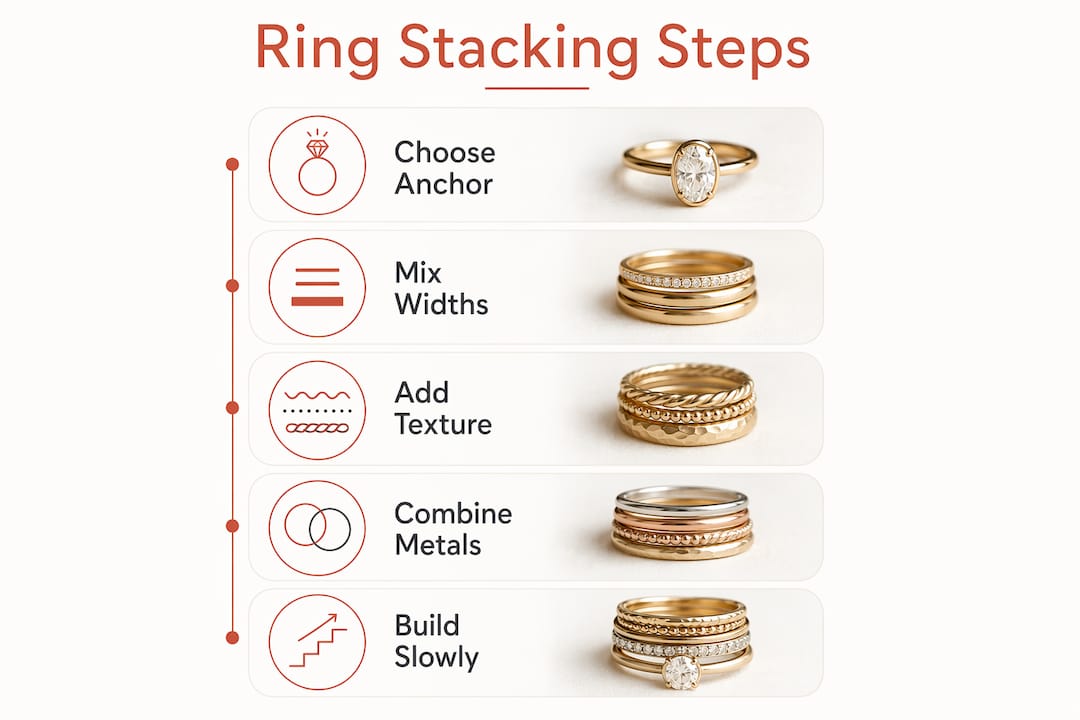
- Start with an anchor ring. According to the GIA 4Cs blog, experts recommend beginning with a strong, meaningful piece, like a signet or bold gemstone ring, as the foundation everything else sits beside.
- Mix widths deliberately. Pair one wider band with two thinner ones to create visual rhythm without clutter.
- Vary metals and textures. Yellow gold next to white gold, polished beside hammered — contrast is what gives a stack depth.
- Leave breathing room. At least one bare finger per hand keeps the look intentional, not overwhelming.
- Limit rings per finger. Two to three rings per finger is the sweet spot for both style and comfort.
The best stacks don’t happen all at once. They accumulate meaning slowly, each ring earning its place.
Table of Contents
- Which ring styles actually work well in a stack?
- Styling do’s and don’ts for stacking rings
- What expert jewelers say about building the perfect stack
- Stacking ideas for every occasion and personal style
- Common mistakes that flatten a stack’s potential
- How to care for your stacked rings and keep them looking sharp
- Trinitycarter’s rings are built for exactly this kind of stacking
- Key Takeaways
Which ring styles actually work well in a stack?
Not every ring is built for layering. The pieces that stack best share a few qualities: a low profile, a comfortable fit, and enough visual character to hold their own without dominating.
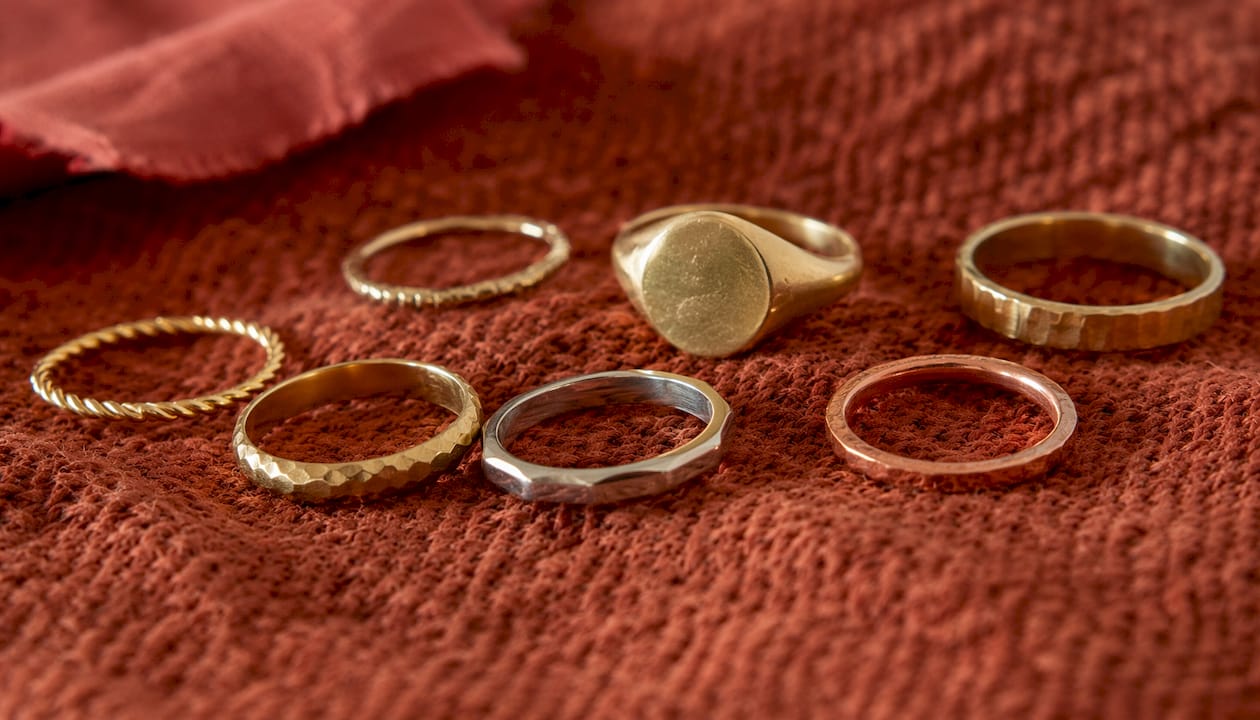
Thin bands are the backbone of most stacks. They sit flush against neighboring rings, add texture or sparkle without bulk, and let you layer three or four without the stack feeling heavy. Pavé-set bands fall into this category and add light without adding width.
Textured rings do something smooth bands can’t: they create tactile and visual interest. Alternating a hammered band with a polished one, or a braided silhouette beside a plain classic, adds what jewelers call the “third dimension” to a stack.
Signet rings and statement pieces work as anchors. They’re wider, bolder, and give the eye somewhere to land. Build around them rather than competing with them.
For rings worn alongside an engagement ring, curved or contoured bands are worth seeking out. They nestle flush against the setting, eliminating the gap that straight bands leave.
Materials that stack well together:
- Yellow gold, white gold, and rose gold (mixing warm and cool tones adds energy)
- Gold-plated pieces alongside solid metal bands
- Crystal-set rings as accent pieces between plainer bands
- Floral or sculptural rings as focal points in a dainty stack
Styling do’s and don’ts for stacking rings
The do’s:
- Do anchor your stack with one bold or meaningful ring. Everything else frames it.
- Do mix metals — contrasting warm and cool tones like yellow and white gold is one of the defining styling moves of 2026.
- Do vary widths. A recommended mix is one wide ring flanked by two thinner rings for visual rhythm.
- Do spread rings across multiple fingers. Stacking doesn’t have to live on one hand.
- Do use odd numbers. Wearing rings on three, five, or seven fingers creates a natural, asymmetric look that feels curated rather than uniform.
- Do leave at least one finger bare. Most people leave the pinky or thumb ringless to give the eye a place to rest.
The don’ts:
- Don’t stack more than three to four rings on a single finger. Beyond that, comfort suffers and the look tips into clutter.
- Don’t use rings of identical width throughout. A stack of same-width bands reads as a uniform block, not a curated collection.
- Don’t buy a pre-planned set and call it done. Sets lack the organic charm of pieces gathered over time.
| Do | Don’t |
|---|---|
| Start with a strong anchor ring | Stack rings of the same width throughout |
| Mix metals and textures | — |
| Leave one finger bare per hand | Buy a matching set as a shortcut |
| Use odd numbers of fingers | Ignore comfort when building a stack |
| Build gradually over time | Overstyle — let the stack breathe |
What expert jewelers say about building the perfect stack
The most useful advice on ring stacking doesn’t come from trend reports. It comes from jewelers who watch people actually wear their pieces day after day.
Jessica McCormack, the London-based jeweler whose work has become a reference point for considered stacking, puts it plainly:
Paris-based jeweler Yvonne Léon takes a similar view, emphasizing balance over formula:
Both jewelers point to the same truth: the anchor ring is the stack’s center of gravity. Once that piece is in place, the rest follows instinctively. Texture is what separates a flat, forgettable stack from one with real presence. Alternating polished, hammered, and pavé-set surfaces creates depth that a stack of identical smooth bands simply can’t achieve.
Pro Tip: Don’t rush the process. A stack built over months or years, with each ring marking something real, will always look more personal than one assembled in a single shopping session.
Stacking ideas for every occasion and personal style
How you stack depends on where you’re going and what you want to say.
Casual, everyday stacks tend to be the most personal. Two or three thin bands on the index finger, a signet on the middle, nothing on the ring finger. Simple, low-maintenance, and easy to adjust. Mixing a floral-inspired ring with a plain gold band adds softness without effort.

Work-appropriate stacks call for restraint. One anchor ring, one thin band beside it, and clean metals. Gold-plated pieces in warm tones read as polished without being flashy. Keep the total count low — two or three rings across both hands is enough.
Evening and formal stacks are where you can push further. Crystal-set bands, mixed metals, rings spread across three or four fingers. This is the moment for a statement anchor and a few dainty companions that catch the light.
Mixing vintage and modern is one of the most interesting things you can do with a stack. A vintage filigree ring beside a sleek contemporary band creates contrast that neither piece could achieve alone. The styles don’t need to match — they need to coexist.
Stacking across multiple fingers and hands:
- Two rings on the index, one on the middle, one on the pinky creates an editorial spread
- Midi rings worn above the knuckle add a modern, layered dimension
- Distributing rings across both hands balances the look and avoids the appearance of clutter on one side
Pro Tip: Check out jewelry trends for 2026 for fresh inspiration on which metals and silhouettes are leading the conversation right now.
For engagement ring wearers, the stack doesn’t have to center on the engagement ring. A signet on a different finger, a thin band on the other hand — the engagement ring becomes one element of a larger, more personal story.
Common mistakes that flatten a stack’s potential
The most frequent error is buying rings that are too similar. Same width, same finish, same metal — the stack ends up looking like a block rather than a collection. Varying at least one element (width, texture, or metal) between each ring is the minimum.
Ignoring comfort is the second mistake. A stack that pinches, catches, or restricts movement won’t get worn. Try the full combination for an hour before committing. Rings that feel fine individually can feel very different together.
Buying too many rings at once, especially as a pre-planned set, tends to produce stacks that look assembled rather than gathered. The charm of a great stack is that it looks like it happened naturally. That’s hard to fake when everything arrives in the same box.
Finally, forgetting ring sizing. Stacked rings sit tighter than a single ring, especially in warm weather when fingers swell. Sizing up by a half size for rings worn in the middle of a stack is a practical move most people only learn after the fact.
How to care for your stacked rings and keep them looking sharp
Stacked rings take more wear than single pieces. They rub against each other, catch on fabric, and accumulate product residue faster. A few habits keep them looking their best.
Remove rings before labor-intensive tasks. The GIA recommends taking rings off when doing anything rough — gardening, gym work, heavy cleaning. Gold-plated pieces are especially vulnerable to abrasion.
Clean regularly. A soft cloth and warm soapy water handles most buildup. For crystal-set or pavé rings, a soft-bristled toothbrush reaches the settings. Avoid ultrasonic cleaners for plated pieces.
Store rings separately when not wearing them. Rings stacked in a drawer scratch each other. A ring dish or individual pouches prevents surface damage.
Avoid contact with chemicals. Perfume, hand lotion, and chlorine all degrade plating and dull stones over time. Put rings on last when getting ready, and take them off before swimming.
Trinitycarter’s rings are built for exactly this kind of stacking
If you’ve read this far, you know what a good stack needs: variety in width and texture, a strong anchor, and pieces that feel personal rather than generic. Trinitycarter’s ring collection is designed with all of that in mind, at a price point that lets you build gradually without committing a fortune to a single piece.

The Multi Tone Trinity Interlinked Ring works as both an anchor and a mixed-metal bridge in one piece. The Triple Crystal Classique Ring adds the kind of light and sparkle that a stack of plain bands can’t replicate. And the Blossom Flowergram Ring brings the floral texture that separates a considered stack from a generic one.
Browse the full Trinitycarter rings collection to find your anchor piece and start building from there.
Key Takeaways
A great ring stack starts with one strong anchor piece and grows gradually through deliberate choices in width, texture, and metal.
| Point | Details |
|---|---|
| Start with an anchor ring | Choose a bold or meaningful ring first; everything else builds around it. |
| Mix widths and textures | Pair one wider band with two thinner ones for visual rhythm. |
| Limit rings per finger | Two to three rings per finger keeps the look stylish and comfortable. |
| Leave one finger bare | At least one ringless finger per hand gives the eye necessary breathing room. |
| Trinitycarter for stacking | The Trinitycarter rings collection offers floral, crystal, and mixed-metal pieces designed to layer and build over time. |
