

Earring styles fall into a handful of recognizable families: stationary studs, drops, motion driven dangles and chandeliers, hoop and huggie shapes, and closure types that determine how secure or comfortable a piece feels. This guide breaks down every major type of earring and back, from Trinity Carter’s Essential V Earring Studs to titanium flat backs, so you can shop by look, occasion, and comfort rather than guesswork.
TL;DR:
- Friction push backs are the least secure option, increasing the risk of losing earrings during daily activities, while locking backs provide maximum security.
- The most common materials for sensitive ears are implant-grade titanium, surgical steel, and 14K or higher gold, which resist irritation and corrosion.
- Smaller earrings like huggies and mini hoops are ideal for stacking and layering, while larger droops, dangles, and chandeliers are suited for evening or special occasions.
- Earrings’ length and movement should match the occasion and your hairstyle; office settings favor studs and short drops, while evening events suit longer dangles and chandeliers.
- Proper care involves cleaning with mild soap for gold and titanium, storing earrings separately to prevent damage, and measuring drop length accurately before purchasing online.
Table of Contents
- Types of Earrings: Every Style and When to Wear It
- Types of Earring Backs and Closures: Security and Fit
- Materials and Hypoallergenic Considerations
- How to Choose Earrings: Face Shape, Hair, and Occasion
- Caring for and Sizing Your Earrings
- Trinity’s Point of View on Everyday Earrings
- Everyday Studs Built for Real Wear
- Sources
Types of Earrings: Every Style and When to Wear It
Every earring style boils down to two things: how it sits on your ear and how much it moves. Once you understand those two variables, every style name on a product page suddenly makes sense.
Stud earrings sit flush against the earlobe with no visible movement. They are the workhorse of any jewelry box because they read as polished at the office and understated enough for daily wear. A classic gold stud, like Trinity Carter’s Everyday Gold Stud Earrings, works under a blazer and under a swimsuit strap without looking out of place in either setting.
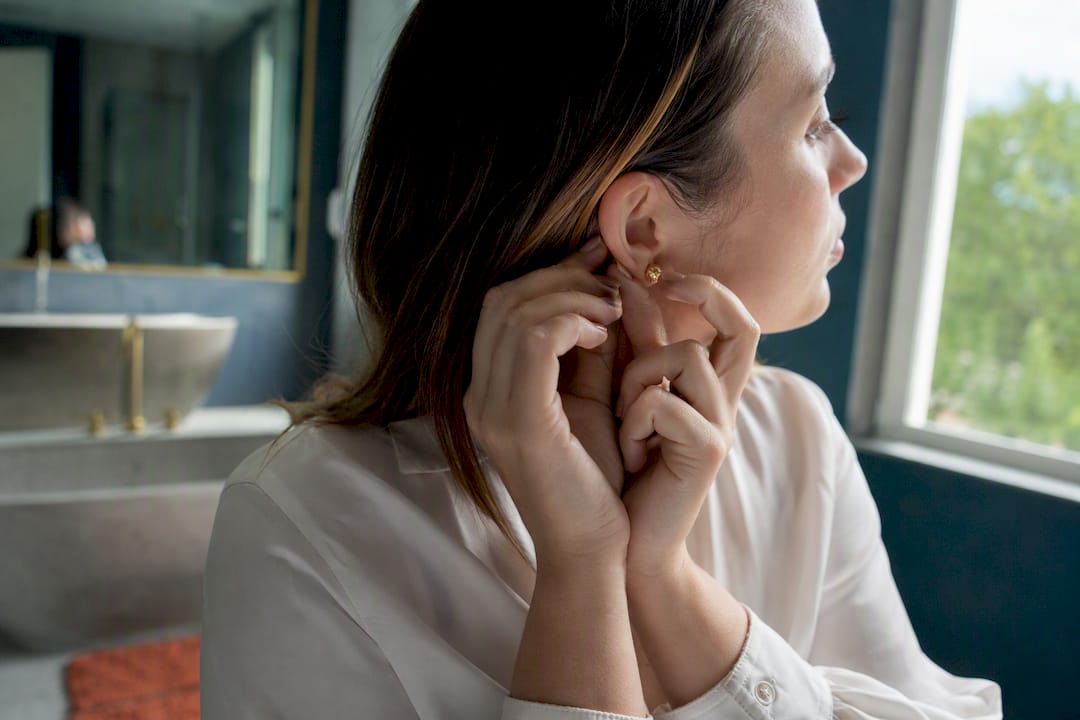
Hoop earrings and huggies are circles or half circles that pass through the earlobe. True hoops range from sleeper size, around one centimeter, up to oversized statement hoops that brush the shoulder. Huggies are the small end of that spectrum: mini hoops that hug the curve of the lobe closely instead of dangling free. Huggies tend to work better for layering multiple piercings, while larger hoops make more of a solo statement.
Drop earrings hang just below the earlobe and stay relatively still once you put them on. Dangle earrings are built to move, often with hinged or articulated sections that swing when you turn your head. That distinction matters more than most shoppers realize: a drop earring typically settles one to three centimeters below the lobe and stays put, which makes it a safer bet for a desk job or a video call. A dangle earring is designed to catch light and motion, so it suits evening events, parties, or any setting where a little sway is the point rather than a liability.
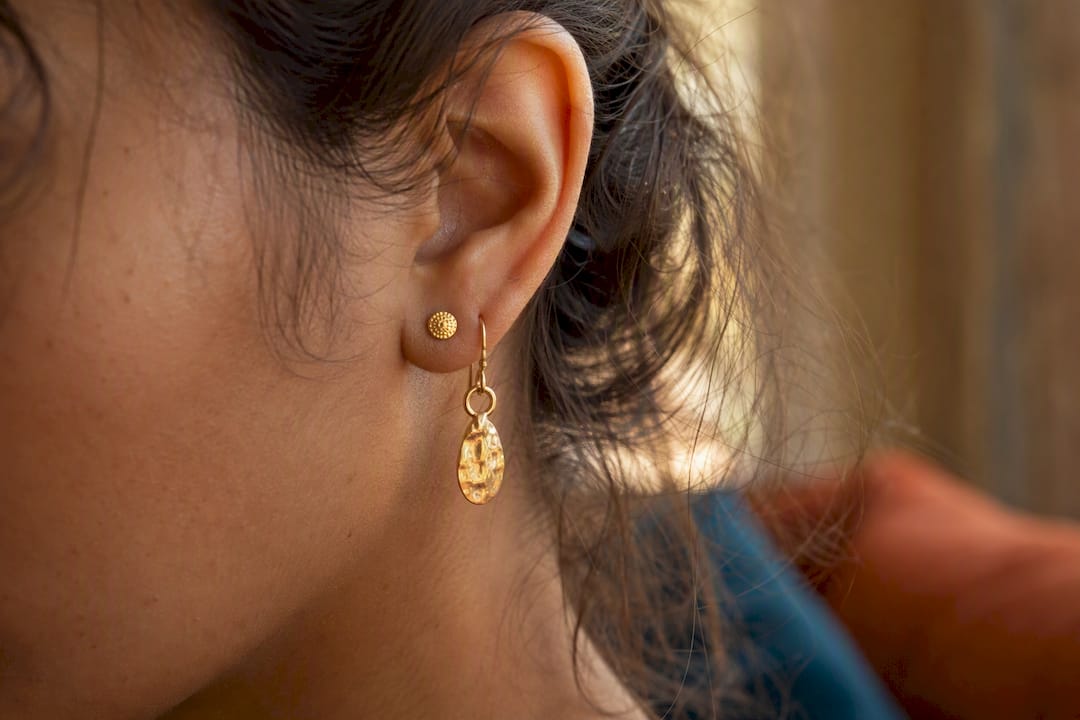
Chandelier earrings take the dangle concept further, branching into multiple tiers of stones or metalwork that fan out below the lobe. These are almost exclusively evening or bridal pieces. Their size and movement compete with everyday activity, so they rarely make sense for a nine to five.
Threader earrings use a thin chain or wire that passes through the piercing and drapes on both sides, letting you adjust how far it hangs. Ear climbers do the opposite: they follow the curve of the upper ear, climbing upward instead of dropping down. Both styles read as more contemporary and tend to show up in the newer wave of jewelry trends rather than in traditional heirloom collections.
Ear jackets clip around a stud from behind so a small front piece and a larger decorative back piece frame the lobe from two angles at once. Ear cuffs skip piercings entirely, wrapping around the cartilage or lobe with tension alone. Both let you build a layered look without committing to extra piercings.
Cluster and single-statement earrings round out the modern lineup. Clusters group several small stones or shapes into one dense piece, often worn as a pair for a cocktail-ready look. The single-statement trend flips that idea: one dramatic earring worn alone, often on the ear with more piercings or simply as an asymmetry choice. Retail guides now document a couple dozen named substyles, including teardrop, linear, cascade, and shoulder-duster shapes, most of which are simply longer or shorter variations on the drop and dangle theme.
Clip-on earrings clamp onto the lobe without any piercing at all, a practical option for anyone who does not have pierced ears or wants to switch styles without swelling or irritation.
A quick reference for length and movement:
- Studs: zero drop, no movement, everyday and office friendly.
- Huggies: sit tight to the lobe, subtle movement, good for stacking.
- Drops: 1 to 3 cm, minimal movement, office to dinner.
- Dangles: 3 cm and up, articulated movement, evening and going out.
- Chandeliers: longest and most elaborate, evening and bridal only.
- Threaders and climbers: variable length, contemporary and cartilage friendly.
Cartilage placements deserve a separate mention. Helix hoops, small studs, and short barbells are now common on the upper ear, often stacked two or three at a time alongside a traditional lobe piercing. That layered look, paired with the single-statement trend on the opposite ear, has become one of the more distinctive shifts in how people wear earrings compared to a decade ago, when matching pairs were closer to the default.
Types of Earring Backs and Closures: Security and Fit
The back of an earring decides whether it stays on your ear or ends up lost in a couch cushion, so it deserves as much attention as the front.
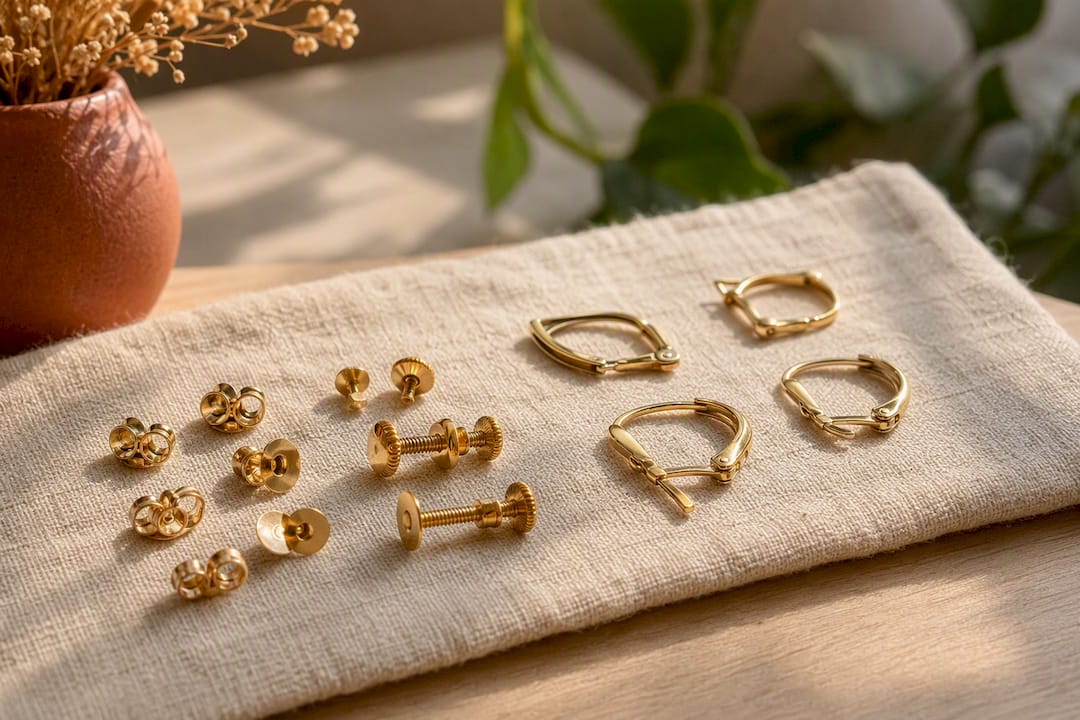
Push or friction backs are the most common closure on stud earrings. A small metal disc slides onto the post and holds by friction alone. They are quick to put on and take off, but that same ease is why they are the easiest type to lose, especially on dangle or hoop styles with any weight to them.
Screw backs thread onto the post like a tiny bolt, giving noticeably more grip than a friction back. They show up most often on higher-value stud earrings meant for all-day wear.
Flat or labret backs use a disc that sits flush against the back of the lobe, with no post protruding outward. They cannot snag on a pillow or a sweater, which is why piercers frequently recommend them for new or healing piercings.
Lever backs use a hinged wire that snaps shut like a tiny latch, common on drop and dangle earrings where a bit of security matters but a screw would be overkill. Latch or hook backs are similar but simpler, an open hook that closes with a small clasp, typically seen on French wire dangles.
Locking backs, sold under names like La Pousette and Alpa, add a secondary mechanism that clicks into place and requires deliberate pressure to release. Silicone and sleeper backs are soft, flexible discs often used on children’s earrings or for sleeping, since they have minimal profile and won’t dig into a pillow. Clicker closures are a hinged, spring-loaded ring popular on cartilage jewelry, snapping open and shut without a separate back piece at all.
Ranked roughly by security, from most to least:
- Locking backs (La Pousette, Alpa): highest security, ideal for heirloom or high-value studs.
- Screw backs: strong hold, good for daily wear on valuable pieces.
- Lever and latch backs: secure enough for drops and lightweight hoops.
- Flat/labret backs: not about grip strength but about a snag-free profile for healing piercings.
- Friction/push backs: convenient, but the least secure of the group.
- Silicone/sleeper backs: low profile, best for sleep or sensitive sizing rather than heavy earrings.
Jewelry care resources consistently point to the same pattern: locking and screw backs rank highest for security, while friction backs, despite being the industry default on most studs, carry the highest risk of an earring simply falling out unnoticed during the day. If you own a pair you would genuinely be upset to lose, swapping a friction back for a screw or locking version is a cheap insurance policy.
Materials and Hypoallergenic Considerations
For sensitive ears, stick to implant-grade titanium, surgical steel, 14K or higher solid gold, or platinum. These metals resist the corrosion and nickel exposure that trigger most earring reactions, which is why piercers reach for them first when someone says regular earrings make their ears itch or turn red.
Gold-plated earrings work differently than solid gold. A plated piece has a thin layer of gold bonded over a base metal, usually brass or a similar alloy. That layer looks identical to solid gold on day one, but it can wear thin with friction, sweat, or harsh cleaning, eventually exposing the base metal underneath. That exposure, not the gold itself, is usually what causes irritation months into wearing a plated piece.
None of that makes plated jewelry a poor choice. It makes it a different choice, one suited to pieces you rotate rather than wear every single day for years. Storing plated earrings separately, keeping them dry, and avoiding harsh soaps all extend how long the finish lasts.
For new or healing piercings, flat back or threadless designs in implant-grade titanium are the safer starting point. Their low profile avoids snagging, and titanium’s inert surface gives irritated skin the best chance to settle before you introduce anything decorative or heavy.
- Best for sensitive ears: implant-grade titanium, surgical steel, 14K+ gold, platinum.
- Best for healing piercings: flat back or threadless posts in titanium.
- Handle with care: gold-plated pieces, since the plating layer is finite.
- Avoid for daily wear if reactive: base metal alloys with no plating or coating at all.
Pro Tip: Before buying, check the product specs for what metal sits under the plating, not just the plating itself. A listing that only says “gold plated” without naming the base metal is worth a follow up question before you buy, especially if you have had reactions before.
How to Choose Earrings: Face Shape, Hair, and Occasion
Picking the right style comes down to four variables: your face, your hair, the occasion, and how the earring actually feels once it is on.
Rounder faces tend to benefit from elongating shapes like drops and linear dangles, while angular faces often look softened by hoops or rounded studs. Hair matters just as much as face shape. Short hair and updos expose the ear fully, so drop and dangle styles get to do their job. Long, loose hair covers small studs almost entirely, so you either need length and movement to peek through or you accept that the earrings are more for you than for anyone looking at you.
Occasion should decide movement level before it decides style name. Office and daytime settings favor studs, huggies, and short drops that will not swing distractingly during a meeting. Evening and formal events are where dangles, chandeliers, and statement single earrings earn their keep. Athletic activity and sleep call for flat, low-profile pieces, ideally with a secure or flush back that will not catch on anything.
- Identify the occasion first: everyday, office, evening, or athletic/sleep.
- Check your hair length and styling habits to decide if you need visible movement or can go minimal.
- Match weight to comfort: heavier chandeliers and long dangles can pull on the lobe after a few hours.
- Confirm the back type suits the use, security for valuables, flush fit for healing or sleep.
- If ordering online, try a similar-weight pair in person first if possible, since earring comfort is genuinely hard to judge from a photo.
Caring for and Sizing Your Earrings
Cleaning routine depends on the metal. Solid gold and titanium tolerate mild soap and water fine, while gemstone-set pieces need gentler handling since harsh chemicals can dull stones and wear down plating or settings over time.
Store earrings flat or hung individually rather than tossed together in a drawer, since tangled chains and clustered studs are what cause both breakage and plating scratches.
To check drop length before buying online, measure from where the earring meets the earlobe to its lowest point in centimeters, then compare that number to a ruler held against your own ear in the mirror.
- Clean gold and titanium with mild soap and a soft cloth.
- Avoid ultrasonic cleaners on gemstone settings unless the seller confirms it is safe.
- Store dangles and hoops separately to prevent tangling.
- Measure drop length against your own ear before ordering longer styles online.
Pro Tip: If a stone-set piece feels loose or a back has lost its grip, get it checked by a jeweler before wearing it again. Professional inspection catches a wobbling setting long before it turns into a lost stone.
Trinity’s Point of View on Everyday Earrings
We design earrings assuming they will be worn far more often than they will be admired in a jewelry box, and that changes every decision from metal choice to closure type. A stud that looks beautiful in a product photo but irritates skin by hour three has failed at its actual job.
That is why our everyday stud designs lean on gold plating over base metals chosen for durability, paired with secure backs rather than the flimsiest friction disc available. If you only own one pair of earrings that gets worn constantly, make it a simple stud in a metal you trust, and treat statement dangles as the occasional pieces they were designed to be.
— Trinity
Everyday Studs Built for Real Wear
Trinity Carter’s Essential V Earring Studs are built around the exact logic covered above: a minimal stud shape, gold plating over a durable base metal, and a back designed to hold through a full day rather than fall out halfway through it.
They pair with almost anything, from office wear to evening layering, and need nothing more than the basic care routine outlined earlier, keep them dry, store them separately, and avoid harsh cleaning chemicals on the plating. If studs aren’t quite your style, browse the full earrings collection for drop and dangle options built with the same material philosophy. Ready to add a reliable everyday pair to your rotation? Check availability on the Essential V Earring Studs product page and see which finish fits your wardrobe.
