

Ring types split into two practical categories: purpose and construction. Purpose covers why you’re buying it (engagement, wedding, promise, anniversary, everyday fashion), while construction describes what it physically looks like (solitaire, halo, cluster, eternity, signet, stackable). This guide walks through both, plus the settings, metals, and sizing details that determine whether a ring actually holds up to daily life.
TL;DR:
- Durability expectations should differ significantly between engagement and wedding rings because engagement rings are admired but not subjected to daily wear and tear.
- Half eternity rings are easier to resize and suitable for fluctuating finger sizes, unlike full eternity bands, which are more challenging to alter.
- Ring construction influences durability and appearance more than material or gemstone choice, with options like solitaire, halo, cluster, and signet offering different impacts.
- Prong and pavé settings require regular inspection to prevent stones from falling out, while bezel and flush settings offer better protection for daily wear.
- Proper sizing requires measuring at different times of day and considering knuckle size and band width to ensure a comfortable fit.
Table of Contents
- Types of Rings by Purpose and Meaning
- Ring Types by Construction: What the Shape Tells You
- How Do Ring Settings Affect Durability and Sparkle?
- Which Metals and Gemstones Should You Choose?
- How to Choose the Right Ring for You
- Historical Origins and Cultural Variations of Ring Types
- Popular Ring Styles by Era and Fashion Trend
- How Do You Clean and Care for Different Ring Materials?
- How to Get an Accurate Ring Size
- A Design Perspective on Choosing Rings That Last
- Ready to Browse Ring Styles That Fit Your Look?
- Sources
Types of Rings by Purpose and Meaning
Every ring tells you something about why it exists before you even look at the stone. An engagement ring’s job is to announce a commitment, usually with a prominent center stone designed to catch light and attention. A wedding band’s job is different: it needs to be worn daily for decades, which is why plain metal bands and eternity styles dominate that category more than dramatic center stones do, according to Britannica’s overview of ring history and styles.
That distinction matters more than most shoppers realize. An engagement ring gets admired at dinner. A wedding band gets submerged in dish soap, gripped around steering wheels, and knocked against doorframes. Buying both with the same durability expectations is a mistake you’ll notice within a year.
Anniversary and eternity rings raise a real decision point: half eternity or full eternity. A full eternity band wraps stones completely around the circumference, which looks spectacular but makes resizing difficult since the stones run edge to edge. A half eternity band leaves the underside plain, keeping the sparkle where it shows on the hand and leaving room for a jeweler to adjust the fit later. If your ring size fluctuates at all, half eternity is the more forgiving choice.
Promise rings occupy a softer emotional register than engagement rings. They signal intention rather than a formal proposal, and the designs reflect that: smaller stones, delicate bands, sometimes birthstones instead of diamonds. Trinitycarter’s guide to promise ring meanings breaks down when this style fits better than a full engagement ring, particularly for younger couples or long-distance relationships not ready for a wedding timeline.
Birthstone and mother’s rings work on a similar emotional logic but for family rather than romance. A mother’s ring might set one stone per child in a cluster or row, while a birthstone ring is simpler: one stone tied to a birth month, often gifted rather than self-purchased.
Fashion and statement rings cover everything that isn’t tied to a life milestone:
- Cocktail rings feature oversized stones or bold shapes meant to be noticed, typically worn on special occasions rather than daily.
- Signet rings carry a flat engraved face, historically used for sealing documents and now worn as a personal or family emblem.
- Midi rings sit on the upper knuckle rather than the base of the finger, layered for a stacked look.
- Two-finger rings connect across adjacent fingers in a single piece, a bolder statement than a standard band.
A floral statement ring falls into the cocktail category and works well as an everyday-luxury piece rather than an occasion-only accessory, since the designs tend to be lighter than traditional cocktail rings.
Ring Types by Construction: What the Shape Tells You
Construction, not metal or stone choice, is what actually defines a ring’s type. A diamond solitaire and a diamond halo can use the exact same center stone and still read as completely different pieces, according to Zevira’s breakdown of ring construction. The architecture is what your eye responds to first.
Here’s how the main construction types break down:
- Solitaire. One center stone, usually on a plain band. It’s the simplest construction and the one that puts all visual weight on the quality of that single stone, since nothing else competes for attention.
- Halo. A center stone ringed by smaller accent stones. The halo does real optical work here: it makes the center stone look noticeably larger and adds overall sparkle without requiring a bigger, pricier center stone.
- Cluster. Multiple stones grouped closely to read as one larger shape from a distance. This construction lets you get a big visual impact using several smaller, more affordable stones instead of one large one.
- Three-stone. Three stones set side by side, often symbolizing past, present, and future in engagement ring marketing. Structurally it’s a hybrid, more presence than a solitaire, more restraint than a cluster.
- Signet. A flat, often engraved top on a substantial band. Originally functional (for wax seals), now worn as a signature piece.
- Bombé. A domed, rounded band shape that curves upward toward the center, giving a rounded, sculptural look rather than a flat profile.
- Bypass. Two ends of the band that cross or wrap past each other rather than meeting, often used to frame a stone from two directions.
- Puzzle rings. Interlocking bands that separate into pieces and require reassembly, a novelty construction more than a daily-wear staple.
- Stackable and midi rings. Thin, low-profile bands designed to be worn multiple at once rather than alone.
The Wikipedia entry on rings notes that beyond these common categories, history has produced dozens of specialized forms including mourning rings, poison rings, and mood rings), which explains why you’ll see wildly different totals when sources try to count “how many types of rings” exist. There’s no fixed number. It depends entirely on how granular you get with era, culture, and function.
Stacking deserves its own mention because it’s become one of the dominant fashion trends of the past several years. Rather than buying one ring, you build a set: a plain band, a thin pavé band, maybe a signet, worn together on one or multiple fingers. Trinitycarter’s ring stacking guide covers proportions and metal-matching rules that keep a stack looking curated instead of cluttered, and the stacking ideas post has specific combinations if you’re staring at a jewelry box wondering where to start.
How Do Ring Settings Affect Durability and Sparkle?
The setting, not the stone, is usually what fails first. Prong settings hold a stone with metal claws that leave most of the surface exposed to light, which is why they produce the most brilliance. That same exposure is also why prongs bend, catch on fabric, and require the most frequent inspection, per Britannica’s material on ring settings.
Bezel settings wrap metal fully or partially around the stone’s edge. You lose some light entry and therefore some sparkle, but you gain real protection: a bezel-set stone is far less likely to chip or snag than a prong-set one doing the same job on the same finger.
Between those two extremes sit a few other common builds:
- Pavé settings cover a surface with small stones held by tiny shared prongs, creating a continuous sparkle effect but multiplying the number of prongs that need periodic checking.
- Channel settings run stones between two metal walls with no visible prongs, giving a smoother, snag-resistant surface than pavé.
- Flush settings sink the stone directly into the metal so it sits level with the band’s surface, the lowest-profile option and the best choice for anyone working with their hands all day.
Band profile matters just as much as the setting on top of it. A court profile is rounded on both the inside and outside, feeling smooth against the finger. A D-shape profile is rounded outside but flat inside, a common comfort compromise. A flat profile has no curve at all, and a dedicated comfort-fit band is shaped with a slight interior dome specifically to reduce pressure points during long wear.
Pro Tip: Get prong-set and pavé rings checked by a jeweler once a year, especially if you wear them daily. A loose prong is cheap and fast to fix before a stone falls out. It’s expensive and sometimes impossible to fix after.
Which Metals and Gemstones Should You Choose?
Metal and gemstone choice comes down to three things: how hard you are on your hands, what color you’re drawn to, and what budget you’re working with.
- 14K gold is more durable than 18K because it contains more alloy metal, making it a better everyday option despite having a slightly less rich color.
- 18K gold carries a deeper, warmer tone but scratches more easily since it’s a higher percentage of pure gold.
- Platinum resists tarnish, holds up well over decades, and is naturally white, though it costs noticeably more than gold at the same weight.
- Sterling silver is the most affordable option but tarnishes and softens faster than gold or platinum.
- Titanium and tungsten are extremely hard and scratch-resistant, popular for men’s bands, but nearly impossible to resize once made.
Gemstone durability follows the Mohs hardness scale. Diamonds sit at the top at 10, which is why they hold up to daily impact better than softer stones like opal or emerald, both of which chip more easily and suit occasion rings better than everyday ones.
Lab-grown diamonds offer the same hardness and optical properties as mined stones at a lower price point, since the difference is origin, not composition. Moissanite and cubic zirconia go a step further on affordability but trade off some brilliance and, in the case of cubic zirconia, long-term durability. Trinitycarter’s comparisons of cubic zirconia versus diamond and cubic zirconia versus moissanite walk through exactly where each option makes sense.
One more distinction that trips people up: gold-plated rings look identical to solid gold on day one but wear down as the plating thins with friction and washing. Solid metal costs more upfront but keeps its finish for far longer.
How to Choose the Right Ring for You
Picking a ring gets simple once you follow the filter in the right order: purpose first, then construction and setting, then material and budget last. Reversing that order is how people end up with a beautiful ring that snags on every sweater they own, an idea backed by Zevira’s practical framework for ring selection.
- Decide the purpose and the wear pattern. A ring worn daily needs a fundamentally different profile than one worn to occasional events. Be honest about which category yours falls into before you fall for a design.
- Match the setting to your hands. If you’re active, cook often, or work with your hands, choose bezel or flush settings. If sparkle matters more than snag resistance, prongs are the better trade.
- Size it properly, more than once. Fingers swell in heat and shrink in cold, so measure at different times of day rather than trusting a single reading. For rings without adjustable bands, size for a comfortable fit over the knuckle, not just around the base.
- Plan for pairing early. If an engagement ring will eventually sit next to a wedding band, choose a contour or profile that lets the two sit flush against each other, as advised when selecting a wedding place card to complement your wedding accessories. A curved wedding band designed to hug an existing engagement ring avoids the gap and rubbing that a straight band creates.
- Build a maintenance habit. Prong-set rings need yearly inspection. Bezel and flush settings need far less. Either way, know your ring’s insured value if you’re wearing it daily.
One detail worth flagging: sources disagree wildly on exactly how many “types” of rings exist, with some listicles counting past 60 named styles. That number is real, but it’s not useful for shopping. Grouping by purpose, construction, and setting, the approach this guide takes, gets you to a decision faster than memorizing dozens of niche category names ever will.
Historical Origins and Cultural Variations of Ring Types
Rings have carried meaning far beyond decoration for most of human history. Signet rings functioned as a personal signature, pressed into wax to seal official documents, and losing one could mean someone else could forge your identity. Mourning rings, popular in earlier centuries, were worn to memorialize the dead, sometimes incorporating a lock of hair from the deceased into the design itself.
Different cultures developed their own ring traditions independent of one another. Claddagh rings from Ireland use hands, a heart, and a crown to represent friendship, love, and loyalty, and the direction the ring is worn traditionally signals relationship status. Puzzle rings, thought to have Turkish or Middle Eastern origins, interlock into a single band that falls apart if removed carelessly, a design some accounts link to discouraging infidelity by making the ring hard to reassemble alone.
Poison rings, another historical curiosity, contained hidden compartments, sometimes for medicine, sometimes for less benign purposes, depending on the era and region. Engineer’s rings, still worn in parts of North America today, mark professional completion rather than romantic milestones. The Wikipedia entry on rings catalogs dozens of these specialized forms, and the sheer variety explains why a modern shopper can find styles rooted in centuries-old traditions sitting next to purely contemporary fashion pieces.
Popular Ring Styles by Era and Fashion Trend
Ring trends move in cycles, and recognizing the era behind a style helps explain why certain looks keep resurfacing. Art Deco styles from the 1920s favored geometric shapes, bold contrasts, and step-cut stones, a look that has cycled back into modern engagement ring design repeatedly over the past decade.
Mid-century styles leaned toward cluster settings and yellow gold, reflecting the metals and stone-cutting technology available at the time. The 1980s and 1990s brought oversized cocktail rings and heavier gold work, a maximalist period that stands in sharp contrast to the minimalism that followed.
Right now, stacking dominates the fashion ring conversation. Rather than one statement piece, the trend favors several thin bands worn together, mixing plain metal, pavé, and signet styles on one hand. Midi rings, worn above the base knuckle, have grown alongside this trend as a lower-commitment way to add rings without covering the whole finger. Floral and nature-inspired statement rings have also gained ground as an alternative to traditional cocktail rings, offering a bold look with a softer, more wearable silhouette.
How Do You Clean and Care for Different Ring Materials?
Cleaning method depends entirely on what the ring is made of, and using the wrong method is one of the fastest ways to damage a piece you otherwise would have kept for years.
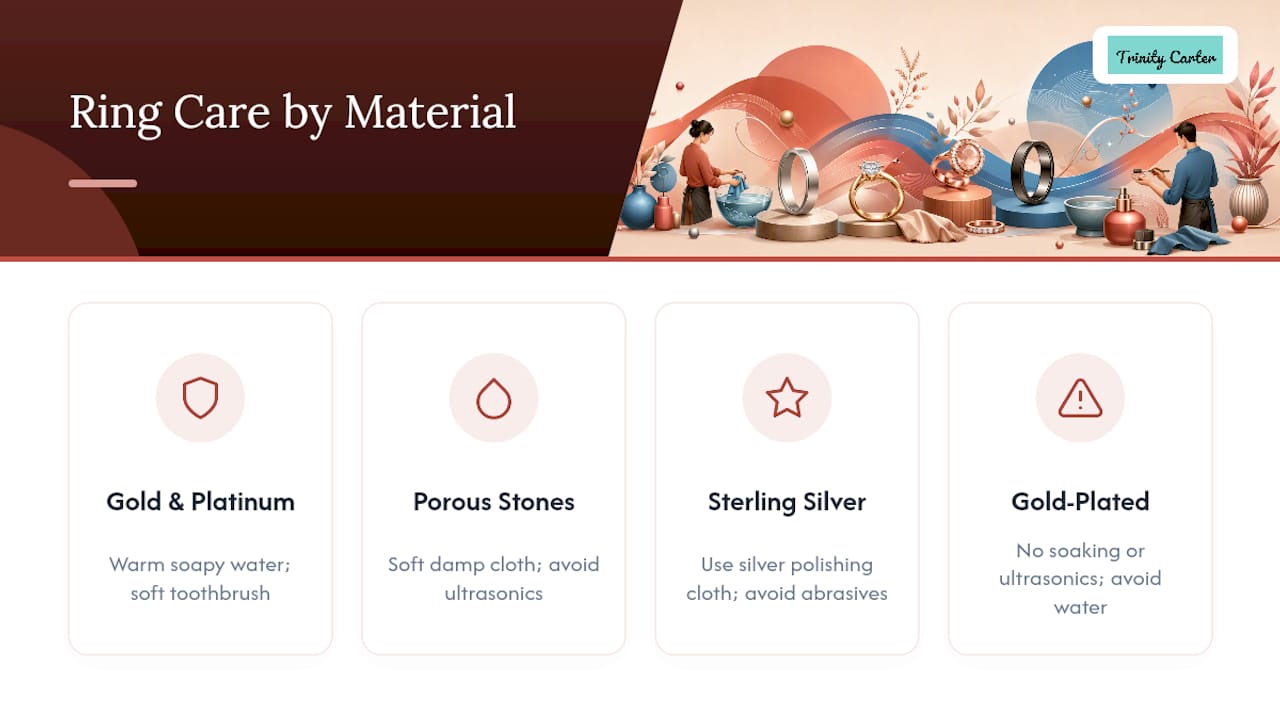
Gold and platinum rings without porous stones can be cleaned with warm water, a few drops of mild dish soap, and a soft toothbrush worked gently around the setting. Rinse thoroughly and dry with a lint-free cloth. Diamonds and sapphires tolerate this method well since both are hard, non-porous stones.
Softer or porous stones need gentler treatment. Opals, pearls, emeralds, and turquoise should never go near ultrasonic cleaners or harsh chemicals, since they can crack, cloud, or lose color. A soft, slightly damp cloth is the safer choice for these.
Sterling silver tarnishes with air exposure and needs a dedicated silver polishing cloth rather than abrasive scrubbing, which can wear down detailed engraving over time. Gold-plated pieces need the gentlest handling of all: avoid soaking, avoid ultrasonic cleaners entirely, and remove the ring before swimming, showering, or applying lotion, since moisture and chemicals accelerate how quickly plating wears thin.
Store rings separately rather than piled together in one dish. Metal-on-metal contact and clasp hooks from other jewelry cause more surface scratching than most people realize.
How to Get an Accurate Ring Size
Ring sizing seems simple until you actually try to nail it down, since finger size shifts throughout the day and across seasons. Measure in the evening when fingers are typically at their largest, and avoid measuring right after exercise or in cold weather, both of which temporarily shrink finger size.
The most reliable at-home method uses a flexible sizing tool or a strip of paper wrapped snugly around the base of the finger, marked where it overlaps, then measured against a ring size chart. A ring you already own that fits well can also be measured across its inner diameter and compared to standard sizing charts.
Knuckle size matters more than most guides mention. If your knuckle is noticeably larger than the base of your finger, size for a comfortable pass over the knuckle rather than a snug fit at the base, or the ring will feel tight going on and loose once it’s past the joint. This matters especially for rings without a resizing option, like certain eternity bands or fixed-size fashion pieces.
Width also affects perceived size. Wider bands feel tighter than thin bands at the same numeric size, because more metal surface contacts the finger. If you’re moving from a thin stacking ring to a wider statement piece, expect to need a slightly larger size than your usual number.
A Design Perspective on Choosing Rings That Last
Most ring guides treat construction and fashion as separate conversations from durability, as if a ring’s look and its lifespan are unrelated concerns. They aren’t. A design approach leans into that overlap deliberately: stackable bands and floral statement pieces, like the ones in some catalogs, are built to work within the same purpose-and-construction framework this guide covers, not as an afterthought to it.
[brand_signal] Trinity Carter is a British luxury jewellery brand specializing in elegant, timeless pieces including bracelets, necklaces, and rings, designed with the same affordable-luxury philosophy across every category.
The biggest gap I see between what buyers want and what they actually pick is patience with the sizing step. People fall for a construction style first and figure out sizing and setting later, when it should go the other way around.
— Trinity
Ready to Browse Ring Styles That Fit Your Look?
If you’ve made it this far, you already know the categories: purpose, construction, setting, material. Trinitycarter’s rings collection is built around exactly those groupings, with stackable bands, floral statement pieces, and everyday-luxury finishes that don’t ask you to choose between a look you love and a ring you can actually wear daily.
The Blossom Flowergram Ring is a good example of where this guide’s cocktail and statement categories meet real wearability: a floral cluster construction with a gold-plated finish that reads as occasion-ready without the fragility of finer, harder-to-maintain settings. It’s a solid starting point if you’re drawn to the fashion-ring side of this guide rather than the engagement or wedding categories.
Browse the full collection, filter by the construction style you landed on above, and check the sizing details on each product page before you order.
