

Adjustable rings are a smart, low-risk pick for everyday wear and gifting, as long as you choose sturdy construction and the right metal. They won’t fit every finger size forever, and thin-wire designs can bend out of shape faster than you’d like. Pick a cast, reinforced piece and you get real comfort, easy gifting, and years of wear. Some collections cover exactly that middle ground, and the details below explain how to spot it.
TL;DR:
- Adjustable rings in cast, reinforced designs in solid gold or vermeil last longer and withstand repeated resizing better than thin wire or plated options.
- Jewelry with an engineered adjustable shank offers a wider, more secure size range, ideal for those managing swelling or finger size fluctuations.
- The advertised fit range and construction quality, especially the presence of visible seams or burrs, are key indicators of a ring’s durability and suitability.
- Avoid fashion open bands for individuals with arthritis or serious sizing needs, as they are less durable and can catch or pinch during daily activities.
- Proper care involves adjusting slowly, cleaning with mild methods suited to the metal, and having a jeweler upgrade worn-out adjustable shanks for lasting security.
Table of Contents
- What Are Adjustable Rings, Exactly?
- Which Styles and Materials Hold Up Best?
- Who Should Buy One, and Who Should Skip It?
- How Do You Pick a Good Adjustable Ring?
- How Do You Care for an Adjustable Ring Without Ruining It?
- Trinity Carter’s Take on Adjustable-Friendly Design
- What This Guide Actually Argues For
- Trinity Carter Picks for Everyday and Gifting
- Sources
- FAQ
What Are Adjustable Rings, Exactly?
An adjustable ring has an opening in the band, usually at the bottom, that lets the metal flex slightly to fit different finger sizes. That’s different from a standard ring, which is soldered into a fixed circle and stays that size forever.
Most fashion adjustable rings use one of three constructions. Open bypass designs have two ends that don’t quite meet, so the band can be gently squeezed narrower or wider. Wrap rings coil around the finger more than once, using that extra length to accommodate size changes. Split-band styles look continuous from the front but have a hidden gap toward the back, which keeps the visual line clean while still allowing movement.
There’s a second, more serious category: engineered adjustable shanks. These are jeweler-installed mechanisms, sometimes hinged, sometimes using a click-and-lock system, built into precious metal settings rather than stamped from thin sheet metal. A jeweler-fitted adjustable shank can expand a ring’s fit range across several sizes and lock securely in place. Fashion open bands simply aren’t engineered to do this.
Here’s what that means in practice for anyone shopping:
- A cast bypass ring typically flexes within a limited size range, usually less than two sizes.
- Wrap rings adapt to swelling but shift position more during activity.
- A retrofitted adjustable shank suits someone who needs a genuinely wide, secure range, like a person managing arthritis.
- No adjustable design replaces a properly sized ring for security during heavy use.
Adjustable doesn’t mean one size fits all. It means a small, useful cushion around your actual size.
Which Styles and Materials Hold Up Best?
Open bypass rings suit stacking and solo wear equally well, since the small gap at the bottom barely shows when worn alone or layered with other bands. Wrap styles read as more of a statement piece and work best solo, since two wrapped rings can crowd a finger fast. Split-band and knuckle or midi styles tend to be the most delicate of the group, better suited to occasional wear than daily grinding through chores and gym bags.
Material matters more than style once you’re thinking about longevity:
- Plated base metal looks the part at a lower price point but the finish wears thinner with repeated flexing at the opening.
- Sterling silver holds shape well and is easy to adjust, though it can tarnish without regular care.
- Gold vermeil (sterling silver with a thicker gold layer) balances look and durability better than standard plating.
- 14K gold fill resists wear far longer than plating, since the gold layer is bonded, not just coated.
- Solid 14K gold is the most durable option and the one that tolerates repeated adjustment without fatiguing.
A cast-in-one-piece bypass design in solid gold tends to outlast rings built from thin bent wire, because the whole band shares the load instead of concentrating stress at a soldered seam. Look for reinforced ends where the band terminates and avoid any ring where the opening feels sharp or unfinished against skin.
Pro Tip: Run your thumb along the inside of the opening before buying. If you feel a seam, burr, or sharp edge, that’s exactly where it will catch on sweaters and skin over time.
Who Should Buy One, and Who Should Skip It?
Adjustable rings solve a specific problem: uncertain or shifting finger size. That makes them genuinely useful for several groups of people.
- Anyone dealing with swelling. Heat, travel, and hormonal changes all shift finger size during the day, and an adjustable design flexes with you instead of cutting off circulation.
- Gift givers who don’t know the recipient’s size. You skip the awkward guessing game entirely, though the design still needs to match her taste to land well.
- People whose weight or finger size fluctuates. Pregnancy, medication changes, and normal weight fluctuation over months make a fixed ring a bad long-term bet.
- Multi-finger wearers. A single adjustable ring can move from an index finger one day to a midi position the next.
The trade-offs are real, though. Open bands can catch on sweaters, gloves, and pockets more than a soldered ring does. A poorly finished opening can pinch skin, and repeated bending, especially in thinner metals, causes fatigue that eventually cracks or deforms the band. During workouts or manual work, an adjustable ring can slide or rotate in ways a fixed ring won’t.
Fixed-size rings still win for engagement and wedding bands, where security and a lifetime of consistent fit matter more than flexibility. For everyday fashion pieces and gifts, though, adjustable designs carry far less downside than most people assume.
How Do You Pick a Good Adjustable Ring?
Start with the advertised fit range. A listing that states a specific range, say, sizes 6 to 8, tells you the maker actually tested the flex rather than just calling it “one size fits most.” That specificity is your first quality signal.
Check the construction next. Photos should show the back of the ring, not just a flattering front angle, since that’s where you’ll see whether it’s cast solid or bent from thin wire. If a listing only shows a close-up glamour shot with no worn-on-hand image at real scale, treat that as a red flag rather than an oversight.
A few more questions are worth asking before you buy:
- Does the seller specify the base metal and plating thickness, or just say “gold-toned”?
- Is there a plating warranty, and what does it actually cover?
- What’s the exchange or return window if the fit isn’t right after wearing it a few days?
- Are there any exposed seams or sharp points along the inside of the band?
Pro Tip: If a ring is a gift for someone managing arthritis or significant swelling, skip the fashion open band entirely and ask a jeweler about installing a proper adjustable shank instead. It costs more, but it’s the only option engineered for daily, repeated resizing without failure.
That last point matters more than most buying guides admit. A $30 fashion ring and a jeweler-installed shank solve different problems, and picking the wrong one for a serious fit need just sets someone up for disappointment.
How Do You Care for an Adjustable Ring Without Ruining It?
Adjust the band slowly, using both thumbs to press evenly on either side of the opening rather than yanking one side wider. Small, even movements protect the metal’s shape; one aggressive bend can throw the whole ring out of round or snap a thinner band outright.
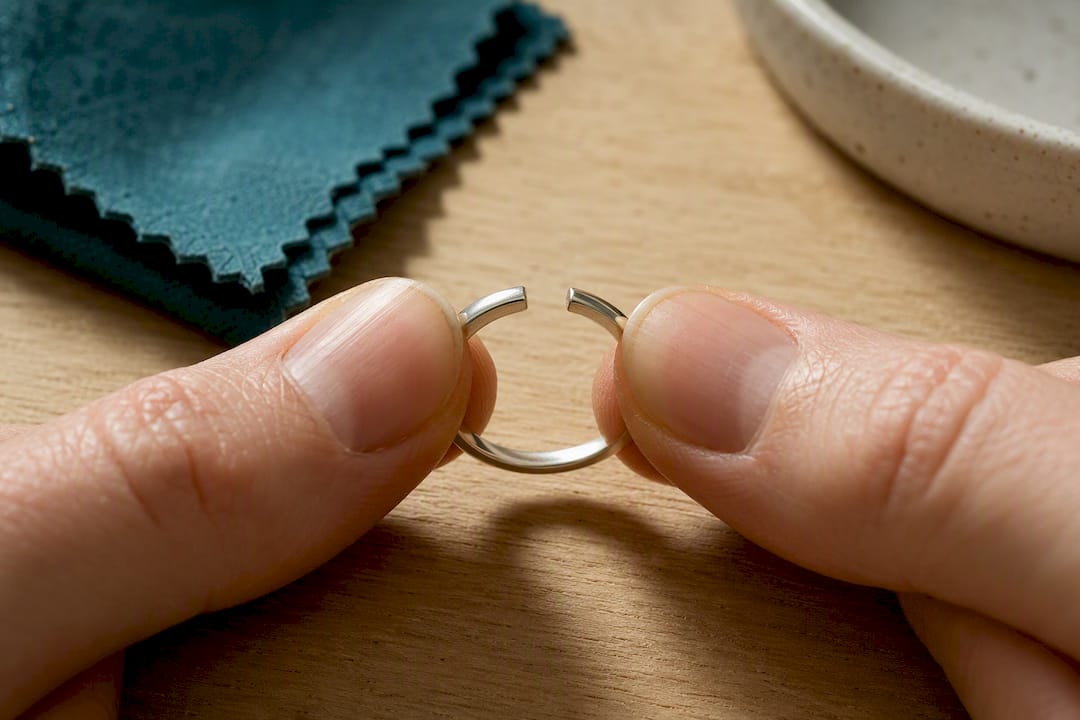
Cleaning depends on the metal. Plated pieces need a soft, dry cloth and should stay away from lotions, perfume, and swimming pools, since chlorine and chemicals wear down the coating fast. Solid gold and sterling silver tolerate mild soap and water but still do better stored dry, ideally in a lined box or pouch rather than tossed loose in a drawer.
A short daily-care checklist:
- Remove the ring before heavy lifting, gym sessions, gardening, or dishwashing.
- Adjust in small increments, never all at once.
- Store plated jewelry away from moisture to slow finish wear.
- Have a jeweler check the band if you notice the opening widening on its own over time.
If a fashion ring stops holding its adjusted shape or starts feeling loose within weeks, that’s your sign to talk to a jeweler about a proper adjustable shank upgrade rather than continuing to force a worn-out band.
Trinity Carter’s Take on Adjustable-Friendly Design
Some brands build designer-inspired, gold-plated pieces around feminine detail that suit adjustable-friendly proportions well. Floral motifs and crystal accents read beautifully on an open bypass band because the visual interest sits at the top of the finger, away from the opening at the bottom where the flex happens.
Delicate, single-band silhouettes translate to adjustable formats more cleanly than wide statement cuffs, which need more metal at the opening to hold their shape. If you’re drawn to a bolder look, our guide on wearing a floral statement ring walks through how to balance proportion with comfort. For anyone shopping specifically around swelling or size uncertainty, our piece on adjustable rings for swollen fingers goes deeper into fit strategy.
What This Guide Actually Argues For
Most advice on adjustable rings treats them as either a gimmick or a miracle fix, and both framings miss the point. The honest read is narrower: adjustable rings are a smart hedge against uncertainty, not a substitute for choosing the right style in the first place.
Where conventional advice falls short is in lumping every adjustable design into one bucket. A thin bent wire ring and a cast bypass piece in solid gold get sold with the same “one size fits all” language, when their real-world durability isn’t remotely close. The construction detail buyers skip past, whether a ring is cast or just bent, is actually the single biggest predictor of how it holds up.
Prioritize the material and construction first, style second, and treat “adjustable” as a comfort feature rather than a size chart replacement. If a ring needs to handle serious daily flexing, a jeweler-fitted shank beats any fashion open band. For everyday wear and gifting, though, a well-made cast piece gets you nearly all the benefit with almost none of the risk.
— Trinity
Trinity Carter Picks for Everyday and Gifting
If you want a ring that gives a little without giving up on style, Trinity Carter’s rings collection is built around exactly that balance: designer-inspired detailing on constructions that hold up to daily wear. The Blossom Flowergram Ring is a good example of the proportions this guide recommends, with floral detail positioned to stay clean-looking even on a flexible band.
Gifting someone whose size you don’t know? An adjustable-friendly piece removes the guesswork without removing the style. Pair it with a matching set, like the Essential V Earring Studs, for a gift that reads thoughtful rather than rushed. Before you check out, confirm the return and exchange window with customer support so a sizing surprise never turns into a stuck purchase. Browse the collection now and pick the piece that matches how you’d actually wear it.
Sources
- Adjustable shanks and ring styles — Stuller
- Adjustable rings vs fixed size rings — BlueStone Blog
- Adjustable rings: fit, sizing, care & gift guide — Soul Lotus
- Flow Gold Open Ring — Black Pearl of Queens
FAQ
Are Adjustable Rings Any Good?
Yes, for everyday wear and gifting, especially cast bypass or wrap styles in solid metal or vermeil rather than thin plated wire. They’re a poor substitute for a fixed-size ring in situations demanding a precise, permanent fit, like engagement bands.
What Are the Disadvantages of Adjustable Rings?
The main issues are catching on clothing, potential pinching from a poorly finished opening, and reduced security during physical activity compared to a soldered, fixed-size ring. Thin metal bands can also fatigue or lose shape if bent repeatedly.
What Do You Call Adjustable Rings?
They’re commonly called open rings, open-band rings, or wrap rings depending on construction, with “adjustable ring” as the general umbrella term. Professionally installed versions are called adjustable shanks.
How Do You Turn a Ring Into an Adjustable Ring?
A jeweler can retrofit an existing ring with an engineered adjustable shank, a hinged or click-lock mechanism that expands the fit range across multiple sizes. This differs from a fashion open band and typically requires professional installation rather than a DIY fix.
Are Adjustable Rings Good for Gifting?
Yes, they remove the need to know an exact ring size, which makes them a practical gifting choice. Success still depends on choosing a design that matches the recipient’s personal style, since fit flexibility alone doesn’t guarantee she’ll love how it looks.
