

Yes, you can wear bracelets with a watch, and the easiest rule is this: treat the watch as your anchor, then add one slim bracelet or a small, deliberate stack around it. Keep pieces that could scratch the case or crystal on the opposite wrist. Everything else is proportion and testing.
TL;DR:
- Pair bracelets with a watch based on the size and durability of the case, ensuring materials won’t scratch or hit the crystal during movement.
- Avoid stacking on the same wrist if the bracelet has hard edges or charms that could scratch the watch or cause contact issues.
- Matching metal tones to the watch case creates a cohesive look, while mixing metals requires a subtle accent in one element to prevent accidental mismatches.
- Keep bracelet fit snug but comfortable, and test movement and contact points to avoid repeated friction or sliding during daily activities.
- Use the anchor-frame-flexible stacking system, starting with the watch, adding a frame piece, then flexible chains or beads, and limit formal or casual stacks to specific piece counts.
Table of Contents
- Quick Starter: The One-Bracelet Rule and How to Test It
- Same Wrist or Opposite Wrist: When to Pair and When to Separate
- Matching Metals and Materials Without Overthinking It
- The Anchor, Frame, and Flexible Stacking System
- Comfort, Fit, and the Sleeve Test
- Matching Bracelets to the Occasion
- Pairings You Can Copy Today
- Care and Maintenance for Bracelets Worn With a Watch
- Making the Pairing Feel Like Yours
- Trinity on Getting the Wrist Right
- Bracelets That Pair Well With Your Watch
- Sources
Quick Starter: The One-Bracelet Rule and How to Test It
Before you stack anything, decide which piece leads. The watch almost always wins that role. It’s the largest object on your wrist and the one with the most fragile surface, so everything else gets arranged around it, not the other way around.
Try this sequence the first time you experiment:
- Put the watch on first and decide whether you’re keeping it solo or adding company.
- Add one slim bracelet in leather, fine chain, cord, or smooth beads. Nothing chunky yet.
- Do the wrist movement test. Raise your arm, lower it, bend your wrist like you’re typing or lifting a coffee cup.
- Watch what happens at contact points. If the bracelet slides into the watch face or clatters against the case, it’s the wrong material or the wrong wrist.
Pro Tip: If a bracelet keeps drifting toward your watch during the movement test, move it to your other wrist before you assume the whole pairing doesn’t work. Sometimes it’s a placement problem, not a style problem.
This same behavior check is what most styling guides recommend before committing to any look, and it takes about ten seconds once you know what to look for, according to The Chic Tribe’s practical fit guidance.
Same Wrist or Opposite Wrist: When to Pair and When to Separate
Same-wrist pairing gives you a layered, intentional look, but it demands two things: wrist room and materials that won’t fight each other. If your wrist is narrow or your watch case is large, cramming a bracelet next to it usually reads as cluttered rather than styled.
Opposite wrist is the safer default, and it’s the one most formal settings call for anyway. You still get to wear a statement bracelet. It just isn’t competing for space or risking contact with your watch’s crystal.
Here’s how to decide:
- Same wrist works when your watch has a durable case, your bracelet is slim or flexible, and you have visible skin between the two.
- Opposite wrist is the better call when you’re wearing a collectible piece, a soft-finish or matte case, or anything with a polished bezel you don’t want dinged.
- Never pair on the same wrist if the bracelet has hard edges, prongs, or charms that could catch on a watch strap or scratch a caseback.
- When in doubt, separate them. You lose nothing stylistically and protect the more expensive item.
Watch collectors themselves are divided on this. Some accept the occasional mark as the cost of a good look; others treat their watch like it’s off limits to anything that touches it, according to British GQ’s reporting on the debate. Your tolerance for wear should guide which camp you fall into, not a style rule someone else made up.
Matching Metals and Materials Without Overthinking It
Matching metal tone to your watch case is the fastest way to look pulled together. Gold watch, gold bracelet, done. It’s a low-risk choice and it reads as intentional even if you spent zero time deliberating.
Mixing metals is fine too, but it needs a rule to keep it from looking accidental. Pick one small repeated detail, a clasp, a bead, an accent link, in the second metal, and let that be the only place the two tones meet. Random mixing without that anchor point usually just looks like you grabbed whatever was on your dresser.
Material matters more than most people think:
- Leather, fabric, and smooth beads are the lowest-risk options next to a delicate watch case because they have no hard edges to scratch anything.
- Polished metal bangles look sharp but move the most, so they’re the pieces most likely to make contact with your watch.
- Rough stones, sharp charms, and anything with prongs should stay off the watch wrist entirely. They’re the most common cause of scratched bezels.
- Textured pieces (hammered metal, matte beads) tend to pair better with a busy watch dial than another shiny surface would.
Pro Tip: If your watch has a satin or brushed finish rather than a high polish, lean toward matte or textured bracelets too. Pairing two different finish types, one glossy and one matte, tends to look mismatched even when the metal tone is identical.
Color should support the watch face, not compete with it. If your dial has a colored accent, pulling that same color into a bead or cord bracelet ties the whole wrist together without anyone consciously noticing why it works.
The Anchor, Frame, and Flexible Stacking System
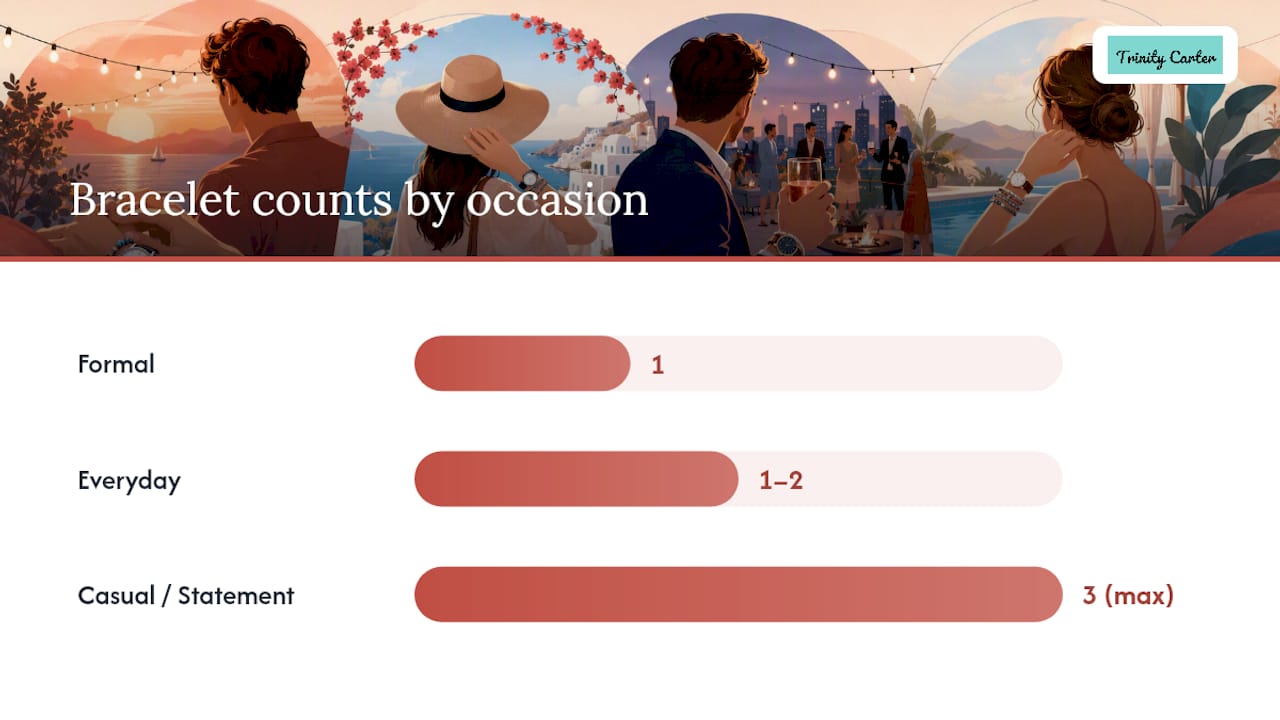
Building a stack that doesn’t look thrown together comes down to order. Start with the watch as your anchor. Add a rigid piece next to it, a bangle or cuff, to act as a frame. Finish with flexible pieces, chains or beads, positioned furthest from the watch. This structure creates a taper that reads as composed rather than random, a method The Times of India’s stacking guide lays out in detail.
Counts matter as much as order:
- Formal occasions: one bracelet, period. The watch is the statement.
- Everyday wear: one to two pieces, keeping the anchor-frame relationship intact.
- Casual or statement looks: three pieces at most. Odd numbers tend to balance better than even ones, visually.
Proportion is the part people skip. A chunky sport watch needs slimmer bracelets around it, or the whole wrist looks heavy. A delicate dress watch can carry a slightly bolder frame piece without getting overwhelmed, since it has less visual weight to compete with.
Before you leave the house, run the final wrist test one more time: move through your normal motions and check for repeated striking or sliding over the dial. If a piece keeps returning to the same contact point, it’s not staying in the stack.
Comfort, Fit, and the Sleeve Test
Fit problems usually show up before style problems do. Slide one finger between the bracelet and your wrist. If it fits snugly with a little room to spare, that’s correct slack. Too loose, and the bracelet migrates toward your watch all day.
- Test under a shirt cuff or jacket sleeve before committing to a stack for a work day. Bunching or pinching at the wrist is a fit issue, not a style one.
- Move bracelets to the opposite wrist during workouts or manual work, since sweat and repetitive motion are exactly when metal-on-metal contact happens most.
- Wipe plated pieces with a soft cloth after wear, and keep perfume and lotion away from finishes when you can. Both accelerate fading on plated metal.
- Recheck slack periodically. Leather and cord bracelets stretch slightly with wear, which changes how they sit next to your watch over time.
This one-finger check, paired with the movement test, is the same standard most fit guidance settles on because it’s simple enough to do without thinking twice, per The Chic Tribe.
Matching Bracelets to the Occasion
Formal settings call for restraint: your watch alone, or one slim, low-contrast bracelet that doesn’t pull focus. Anything louder starts to look like you’re trying too hard.
Work environments need pieces that stay quiet, literally. Low-profile, close-fitting bracelets that don’t click against a desk or a keyboard all day are the ones that actually get worn twice.
Casual settings are where you get to play. More texture, more color, small stacks are all fair game, as long as the watch face stays readable and isn’t buried under everything else.
- Skip bracelets entirely when you’re doing physical work, swimming, or anything where jewelry becomes a hazard rather than an accessory.
- Job interviews and client meetings call for the formal rule even if the dress code is technically casual.
Pairings You Can Copy Today
Some combinations just work, and you don’t need to reinvent them every time. Here’s where to start based on what’s already on your wrist:
- Minimal dress watch: a thin gold chain or a leather cord in a neutral tone. Nothing competes with the simplicity of the dial.
- Metal bracelet watch: a slim chain or smooth bead bracelet in a matching tone, worn on the same wrist since the metal-to-metal already reads as cohesive.
- Chunky sport watch: a slim braided leather piece on the opposite wrist, or one low-profile bead bracelet if you want same-wrist company.
- Work outfit: watch plus one thin gold bangle, quiet enough to survive a full meeting schedule.
- Weekend outfit: watch plus a two-piece stack, one bead bracelet and one cord, on the same wrist for a relaxed layered look.
- Date-night outfit: watch on one wrist, a single statement cuff on the other, letting each piece get its own moment.
Care and Maintenance for Bracelets Worn With a Watch
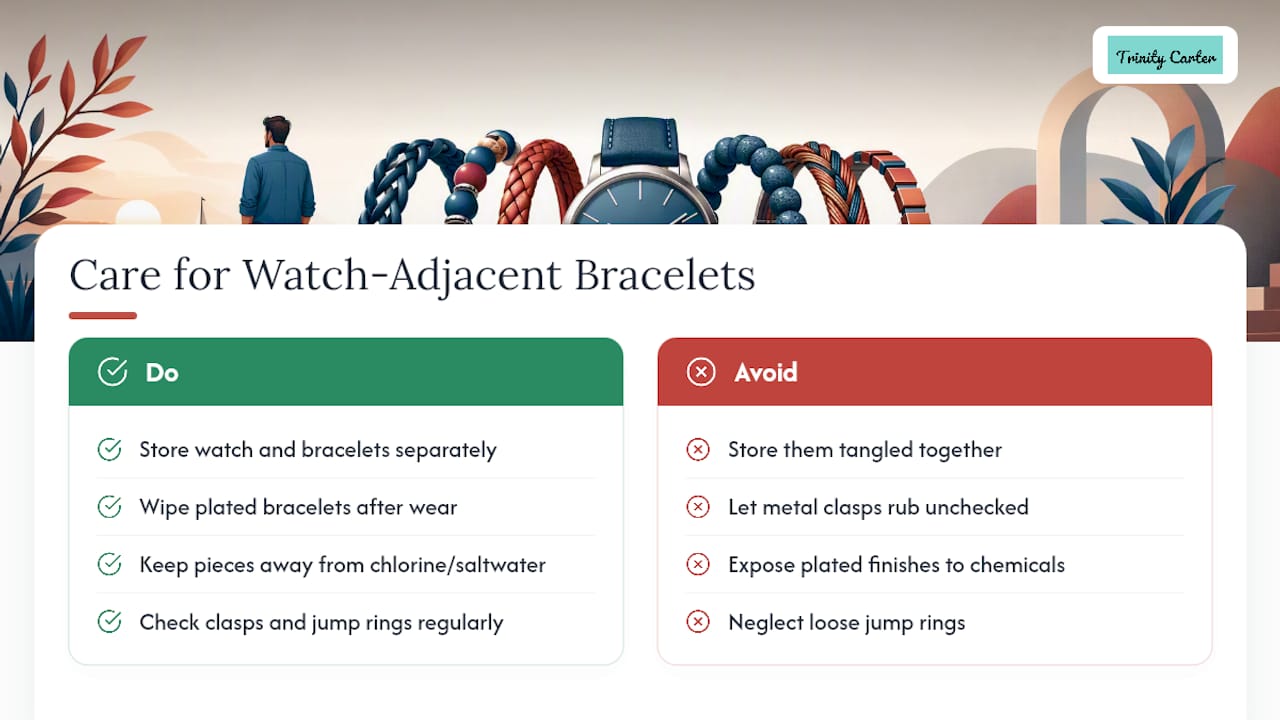
Bracelets that live next to a watch every day take more abuse than the ones you swap out occasionally, so they need a slightly different care routine. Store your watch and bracelets separately rather than tangled in the same dish. Metal clasps and watch bands snag on each other, and repeated tangling stresses both pieces at their weakest points.
Wipe gold-plated bracelets with a soft, dry cloth after wear, especially if they’ve been in contact with a metal watch band all day. Friction between two metal surfaces removes plating faster than normal wear alone would. Keep both pieces away from chlorine, saltwater, and household cleaning products, since plated finishes are especially vulnerable to chemical exposure.
Check clasps and jump rings on any bracelet you wear alongside a watch regularly. The extra contact and movement put more stress on connection points than a bracelet worn alone. A loose jump ring next to an automatic watch is how you lose a bracelet without noticing until it’s gone.
If you rotate between a few bracelets, give each one a break rather than wearing the same piece daily against the same watch. This spreads out the wear on both items and keeps any one pairing from developing a rubbed or dulled contact point where they repeatedly meet. It’s a small habit, but it noticeably extends how long plated pieces keep their finish.
Making the Pairing Feel Like Yours
Rules only get you so far. The best wrist combinations reflect something specific about how you actually live and dress, not just a formula copied from a guide. Start by noticing what you already gravitate toward, warm metals or cool ones, delicate pieces or bolder ones, and build your stacking choices around that instinct instead of overriding it.
Personalization also means adjusting the anchor-frame-flexible system to fit your actual routine. If you’re at a desk all day, your frame piece can be slightly bolder since it’s not getting knocked around. If you’re active and hands-on, lean toward flexible, low-profile pieces you can forget you’re wearing.
Consider what a piece means to you, too. A bracelet from a specific trip, a gift, a piece tied to a milestone, deserves a spot in the rotation even if it doesn’t perfectly match your watch’s metal tone. Style guides can tell you the mechanics of pairing. They can’t tell you which piece you’ll actually reach for on a Tuesday because it feels like you. That instinct, paired with the practical checks, is what makes a stack look effortless instead of assembled.
Trinity on Getting the Wrist Right
My take on this: the bracelet should support the watch, never compete with it. Most people overstack because they’re thinking about the bracelet in isolation, not about what it looks like next to a dial they’re already wearing. Read the cuff styling guide if you want more on balancing a bolder frame piece, and the Essential V guide for slimmer, everyday pairings. One practical note: gold-plated pieces need a soft cloth and a break from lotion and perfume to keep their finish honest over time.
— Trinity
Bracelets That Pair Well With Your Watch
If you’re ready to test the anchor-and-stack method, a few pieces make the transition easy. A slim, adjustable bracelet that sits close to the wrist works well as a low-profile frame piece for formal and work outfits. A bracelet with more presence but not loud can be a solid choice for same-wrist pairing that reads as deliberate rather than accidental. An adjustable gold bracelet from the bracelet collection rounds things out for anyone who wants to match metal tone to their watch without overthinking the fit.

On sizing, check the product page for adjustable lengths before you buy. A bracelet that’s even slightly too loose will drift toward your watch during the day, which defeats the whole point of a tested pairing. Finish matters too: a brushed or satin option will sit better next to a matte watch case than a high-polish piece would. Start with the Essential V Bracelet if you want the safest first stack to try against a dress watch this week.
Sources
For more on stacking mechanics and material choices, see British GQ’s take on wearing bracelets and watches together, Totapari’s 12 principles for judging bracelet behavior, The Chic Tribe’s fit guidance, and The Times of India’s stacking guide. For brand-specific styling, browse the statement cuff guide and gold bracelet styling tips.
- A bracelet and watch – can you wear them together at the same time? | British GQ
- Elevate Your Style: The Ultimate Guide to Stacking Watches and Bracelets | - The Times of India
- How To Wear A Watch And A Bracelet - The Chic Tribe
