

Choose earrings that push back against your face’s strongest dimension: elongate a round face, add width to a long one, soften a sharp jawline, and lift focus toward the cheekbones on a heart or diamond shape. That single rule, more than any trend list, decides whether a pair actually flatters you. The guide is built around that principle so you can shop with a clear picture of what to look for instead of guessing at the mirror.
TL;DR:
- Long and linear earrings, such as teardrops and geometric shapes, enhance the appearance of round faces by creating vertical lines and reducing roundness.
- For square faces, rounded hoops, oval, and teardrop shapes soften angular jaws, while angular earrings tend to reinforce sharp features.
- Heart-shaped faces benefit from bottom-weighted earrings like teardrops and chandeliers, which draw attention downward and balance a wide forehead.
- Earrings for long or rectangular faces should add width with shorter, wider styles like studs and button earrings, avoiding elongating drops.
- Prioritizing lightweight materials, secure fastenings, and scale matching to facial proportions ensures comfort and prevents earrings from slipping or causing discomfort throughout the day.
Table of Contents
- Earrings for Face Shape: How to Find Your Match Fast
- Oval Faces: The Shape That Wears Almost Anything Well
- Round Faces: Add Length and Angles, Not More Curve
- Heart-Shaped Faces: Balance a Wide Forehead With a Narrow Chin
- Square Faces: Bring In Curves to Soften Strong Angles
- Long or Rectangular Faces: Add Width Instead of More Length
- Diamond Faces: Frame the Cheekbones, Don’t Fight Them
- Buying Checklist: Comfort, Fit, and Fastenings That Actually Hold Up
- What some designers get right about fit and wear
- Rules Are a Starting Point, Not a Verdict
- Shop Trinitycarter’s Earrings by Face Shape
- Sources
- FAQ
Earrings for Face Shape: How to Find Your Match Fast
You don’t need calipers or a geometry lesson to figure out your face shape. Pull your hair back, stand in front of a mirror in even light, and either trace the outline on the glass with a dry-erase marker or snap a straight-on photo with your phone propped at eye level.
Once you have that outline, run through three quick checks:
- Compare forehead, cheekbone, and jaw width. Note which is widest. A forehead that’s clearly the broadest point usually signals a heart shape; even width top to bottom points toward square or round.
- Measure length against width. Hold a ruler to the photo, or eyeball it. If your face is noticeably longer than it is wide, you’re likely oval or rectangular. Close to equal usually means round or square.
- Look at the jawline. Soft and curved suggests round or oval. Sharp corners suggest square. A narrow, pointed chin under wider cheekbones usually means diamond.
Match those three answers to the categories below: oval, round, heart, square, long or rectangular, and diamond. Most people land close to one, even if no face is a textbook shape. Jewelry expert Blake Asaad has pointed out that face shape is the detail most shoppers skip entirely, even though it changes which silhouette actually reads as flattering.
Oval Faces: The Shape That Wears Almost Anything Well
An oval face has balanced proportions, forehead, cheekbones, and jaw taper gently with no single feature dominating. That balance is exactly why oval faces can wear nearly any earring style without a downside.
Studs, huggies, medium drops, hoops, and even statement pieces all sit well here because there’s no strong angle or length to correct. The one place to use judgment is scale.
- Studs and small huggies work for everyday wear and don’t compete with your features.
- Medium drops add polish without overwhelming a shorter neck.
- Hoops in any diameter tend to flatter because they echo the face’s natural curve.
- Statement drops work well for dressier occasions since there’s no jawline to fight against.
What to skip: extremely long, shoulder-grazing chandeliers can over-elongate an oval face, especially on someone with a shorter neck, dragging the eye downward past where you want it to stop.
Pro Tip: If your neck is on the shorter side, cap drop length around 2 inches. Anything longer starts to compete with your neckline instead of complementing your face.
Round Faces: Add Length and Angles, Not More Curve
A round face has similar width and length with soft, curved edges, and the goal is straightforward: introduce vertical lines and angles to create the illusion of length.
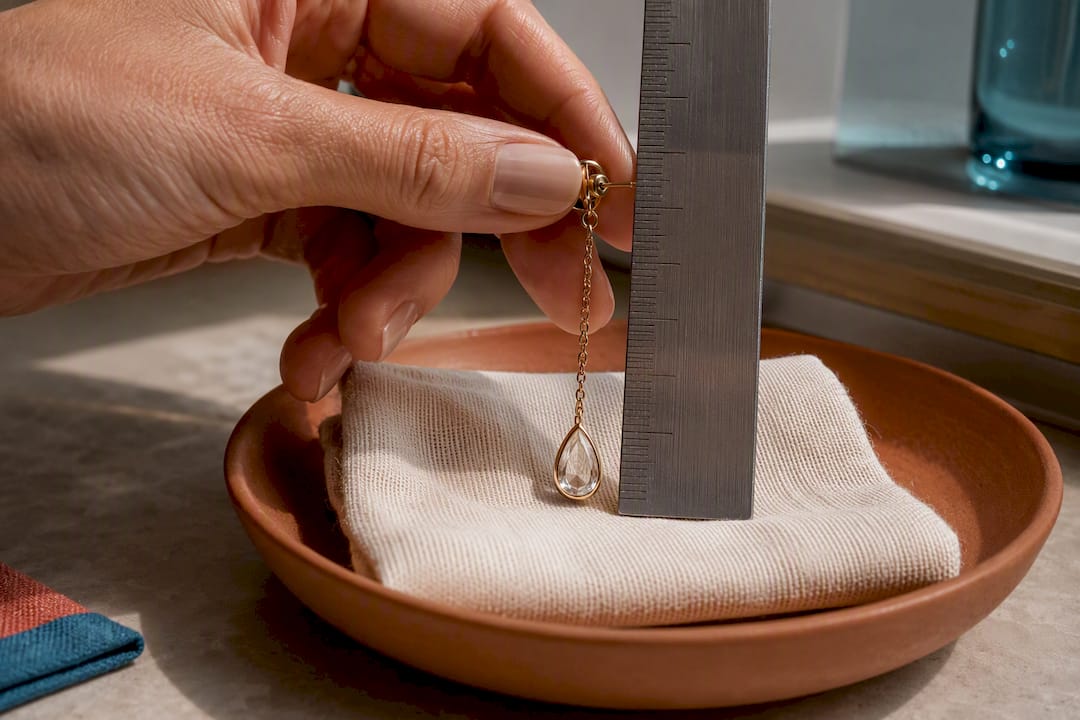
Long drops, linear dangles, teardrops, and slim geometric shapes all pull the eye downward and thin out the face visually. Corroborating style guidance backs this up, pointing to vertical lines as the most reliable tool for a round face specifically.
- Long linear drops stretch the eye downward.
- Angular geometric shapes, like elongated hexagons or rectangles, cut against the roundness.
- Teardrop silhouettes taper the face without adding bulk near the cheek.
- Slim chandeliers work if the design stays narrow rather than wide.
Avoid large round hoops and chunky button studs. Both echo the roundness already present and can make cheeks look fuller than they are. If you wear your hair down, a side part paired with drop earrings amplifies the elongating effect. Round or oversized glasses frames tend to fight this goal, so square or angular frames pair better with round-face earring choices.
Heart-Shaped Faces: Balance a Wide Forehead With a Narrow Chin
A heart-shaped face carries width at the forehead and cheekbones that tapers to a narrow, sometimes pointed chin. The fix is to draw visual weight downward, below the cheekbones, so the chin doesn’t look as delicate by comparison.
Teardrops, triangular drops, and chandeliers that flare wider at the bottom than the top all do this job well.
- Teardrop earrings widen gradually and settle weight near the jaw.
- Triangular drops mirror the face’s natural taper but reverse the emphasis.
- Bottom-flared chandeliers add fullness exactly where a heart face needs it.
- Rounded drops soften the point of the chin without overwhelming it.
Skip top-heavy studs and narrow, straight-hanging designs. Anything that adds visual bulk near the temple only exaggerates the width you’re already trying to balance. The fit test is simple: hold the earring up to your face and check that its widest point falls at or just below your jawline, not above it.
Square Faces: Bring In Curves to Soften Strong Angles
A square face has a broad forehead, wide jaw, and minimal taper, with the jawline reading as the most defining feature. Curved, rounded shapes contrast that structure and soften the overall look without disguising it.
Rounded hoops, oval and teardrop shapes, curved drops, and pearl clusters all work in the same direction.
- Rounded hoops (any size) counter the jaw’s straight lines with a continuous curve.
- Oval and teardrop drops soften the transition from cheek to jaw.
- Curved, S-shaped dangles break up the angularity without looking busy.
- Clustered pearls or rounded gemstones add softness near the ear without a sharp outline.
Steer clear of geometric, square, or heavily angular earrings. They repeat the jawline’s shape and reinforce the very feature you’re trying to soften. On drop length, mid-length (roughly 1.5 inches) tends to hit the sweet spot, long enough to draw the eye but short enough not to compete with jaw width.
Long or Rectangular Faces: Add Width Instead of More Length
A long or rectangular face already has plenty of vertical length, so the last thing it needs is another elongating earring. The goal flips here: add horizontal width and keep the visual weight close to the ear rather than hanging below it.
Studs, cluster studs, medium hoops, and wider button-style earrings all work in this direction.
- Cluster studs add width right at the earlobe without adding drop length.
- Medium hoops (1 to 1.5 inches) create a horizontal line that shortens the perceived face length.
- Wide button studs sit flush and widen the lower face area.
- Textured or scalloped-edge studs add visual interest without pulling the eye downward.
Avoid long, narrow drops and thin vertical dangles. Both do the opposite of what a long face needs, stretching it further. If you’re also working with a short haircut or a crop, pairing it with wider earrings and a shorter necklace balances the extra length that a longer hairstyle or long necklace would otherwise add.
Diamond Faces: Frame the Cheekbones, Don’t Fight Them
A diamond face has narrow forehead and jawline with the cheekbones as the widest point, and the styling goal is to complement that natural highlight rather than compete with it. Oval studs, teardrops, and rounded shapes that sit at or near cheekbone level do this best.
- Oval or round studs anchor attention right at the cheekbone without adding width elsewhere.
- Teardrop shapes taper gently, echoing the face’s own narrowing lines.
- Rounded, curved drops soften the diamond’s angularity at both the forehead and chin.
Avoid narrow, top-heavy earrings that pull focus upward and away from the cheekbones, the feature you actually want to show off. One underused trick: placing a second piercing higher on the ear, like the helix or upper lobe, shifts a small amount of visual weight upward, which can offset a narrow forehead without changing your main lobe earrings at all.
Buying Checklist: Comfort, Fit, and Fastenings That Actually Hold Up
Choosing the right silhouette only gets you halfway. An earring that looks perfect in a photo but pinches after two hours or slides forward on your lobe won’t get worn twice.
- Weight first. Heavier drops and chandeliers pull earlobes forward over the course of a day. If you have thinner or stretched piercings, lean toward lighter metals and smaller stones.
- Fastening type. Push-backs are easiest for daily wear but can loosen. Screw-backs hold securely for active days. Leverbacks suit dangles and drops since the hinge keeps the earring facing forward instead of twisting.
- Scale against your jawline. A rough rule: drop length should stay under a third of the distance from your earlobe to your chin, or the piece starts to look disproportionate rather than intentional.
- Material and plating. Sensitive ears do better with gold-plated or hypoallergenic posts. Check care instructions since plating can wear thin with daily contact against skin, hair products, and perfume.
- Test before you commit. For online shopping, take a straight-on photo with your hair pulled back and hold your phone at the earring’s actual size against your jaw to see where the widest and lowest points fall. In-store, try the pair on and turn your head side to side. If it swings into your neck or catches on your collar, size down.
Pro Tip: Snap the try-on photo in daylight near a window. Indoor lighting distorts proportions and makes drop earrings look shorter than they’ll actually appear outside.
What some designers get right about fit and wear
Good styling advice only matters if the earrings themselves are built to hold their shape and stay comfortable through a full day. Some designs are made with that balance point in mind, where the weight of the drop or stud sits, not just how it looks in a flat product photo.
- The Essential V Earring Studs work as a genuinely versatile option, small enough for long or diamond faces, clean enough to layer with a second piercing for heart or oval shapes.
- The Gold Essential V Earring Studs give the same silhouette in a warmer finish, useful if you’re testing which metal tone reads better against your skin before committing to a drop style.
- The Forever Love Heart Stud Earrings lean into a bottom-weighted heart motif, a natural fit for anyone using the heart-face or square-face guidance above.
Every piece follows the same everyday-wear logic outlined in Trinitycarter’s guide to avoiding irritation and loss: secure fastenings, lightweight construction, and plating that holds up against daily contact. Studs built for comfort tend to become the pair you actually reach for, not the pair you save for special occasions and then forget how to fasten.
Rules Are a Starting Point, Not a Verdict
Every rule in this guide exists to help you make a faster decision, not to talk you out of a pair you love. If a chandelier earring makes you feel sharp on a round face, wear it. Confidence changes how a piece reads on you more than a diagram ever will.
What I’d actually suggest: don’t overhaul your entire jewelry box based on face shape alone. Try one small adjustment first, a slightly longer drop, a rounder stud, a second piercing placement, and see how it feels before you decide the whole category is off-limits.
— Trinity
Shop Trinitycarter’s Earrings by Face Shape
Trinitycarter designs earrings around the same balance points covered in this guide, so you’re not stuck decoding vague product descriptions to figure out whether a stud will elongate, soften, or add width to your particular face. If you have a rounder or longer face, the Essential V Earring Studs work in gold or silver tones depending on which reads better against your skin.
If you landed on heart or square in the quick check above, the Forever Love Heart Stud Earrings echo the bottom-weighted silhouette that guidance calls for without needing a drop earring at all. Browse the full earring collection and check sizing details on each product page before you check out.
Sources
- How to pick the most flattering earring style for your face shape: Jewellery expert reveals - The Times of India
- How to Pick the Most Flattering Earrings for Your Face Shape, According to a Jewelry Expert - Glam Globe Magazine
- The earrings to wear and avoid for each face shape - Cosmopolitan
FAQ
What earrings suit my face shape best?
It depends on your shape’s dominant feature: elongating drops for round faces, bottom-weighted designs for heart faces, curved shapes for square faces, and nearly anything for oval faces, since balanced proportions accommodate most silhouettes.
What kind of earrings should I wear if I have a round face?
Choose long, linear drops, teardrops, or slim geometric dangles that add vertical length. Skip large round hoops and chunky studs since they emphasize the width already present.
What type of earrings make your face look slimmer?
Vertical, elongating shapes like linear drops and teardrops create the visual effect of a slimmer, longer face, particularly on round or square shapes where width is the dominant feature.
What piercing suits my face shape?
Standard lobe piercings work for most face-shape styling, but a second piercing placed higher, like the helix or upper lobe, can shift visual weight upward, which helps diamond and heart faces balance a narrower forehead.
Does earring size matter as much as shape?
Yes. A flattering silhouette in the wrong scale, too long for your neck or too wide for your jawline, loses its effect, so match both shape and length to your face’s proportions before buying.
