

Platinum, implant-grade titanium (ASTM F136), niobium, tantalum, and high-karat nickel-free gold is the most reliable choice for anyone whose skin reacts to jewelry. The catch: “hypoallergenic” is a marketing term with no legal definition, so it guarantees nothing. Even gold-plated or “surgical steel” pieces can trigger a reaction once the base metal underneath makes contact.
TL;DR:
- Only implant-grade titanium (ASTM F136), niobium, or high-karat nickel-free gold are reliably safe for sensitive skin, especially during initial piercings.
- Nickel is the main allergen in most jewelry, often present in white gold, stainless steel, and plated or coated pieces, and triggers immune reactions when contact is prolonged or skin is broken.
- “Hypoallergenic” labels lack regulation and are unreliable; trust material claims like “nickel-free” or verified standards over vague marketing terms.
- Lab testing or detailed material disclosure is essential before buying jewelry for nickel sensitivity, especially for daily wear or active lifestyles.
- Proper jewelry care, including avoiding harsh cleaners and chemicals, extends jewelry lifespan and reduces skin irritation risk.
Table of Contents
- What “Hypoallergenic” Actually Means (and Why Nickel Is the Real Problem)
- The Best Metals for Sensitive Skin, One by One
- How to Spot a Reactive Piece Before You Buy It
- Matching the Metal to Your Sensitivity Level
- Caring for Hypoallergenic Jewelry So It Stays That Way
- What the Experts and Standards Actually Say
- How Trinity Carter Approaches Sensitive Skin
- Shop Nickel-Conscious Collections at Trinity Carter
- Trinity Carter’s Take on Buying for Sensitive Skin
- Sources
What “Hypoallergenic” Actually Means (and Why Nickel Is the Real Problem)
No regulatory body defines “hypoallergenic” for jewelry. Brands can print it on any product, plated or solid, without proof. “Nickel-free” is different: it’s a material claim about what’s actually in the alloy, and it’s the phrase worth trusting over the vaguer one.
Nickel triggers most jewelry-related skin reactions. It’s cheap, it alloys well with other metals, and it shows up in white gold, low-grade stainless steel, and the base layer under a lot of gold or rhodium plating. When nickel touches skin, especially skin that’s already sweaty or irritated by friction, it can trigger an immune response called allergic contact dermatitis. Redness, itching, small blisters, and flaking around earlobes, wrists, or fingers are the classic signs.
Research reviewing metal allergy in piercing patients found that piercings are strongly associated with nickel sensitization, and lab testing has caught jewelry releasing nickel above safe thresholds even when labeled otherwise. A few things make exposure worse:
- Sweat accelerates metal ion release from the surface of cheap alloys.
- Constant friction, like a ring rubbed against a steering wheel all day, wears through thin plating faster than you’d expect.
- Broken skin, from a fresh piercing or an existing rash, absorbs more metal than intact skin.
The American Academy of Dermatology notes that nickel allergy is common, which is exactly why so many people assume they have “sensitive skin” when the actual issue is one specific metal they keep buying jewelry made from.
The Best Metals for Sensitive Skin, One by One
Not every “safe” metal is safe for every person, and that’s the part most buying guides skip. Here’s what actually matters for each option.
It’s dense, it doesn’t tarnish, and it’s about as inert against skin as metal gets. The tradeoff is cost. It’s the priciest option on this list, which is why it shows up most often in wedding bands and heirloom pieces meant to be worn every day for decades rather than in costume jewelry. When shopping, look for a stamped purity mark (950 Pt or similar) rather than a generic “platinum finish” claim, which usually means plating over something else entirely.
Implant-grade titanium. This is the material piercing professionals reach for first, and for good reason. The key distinction is between generic titanium, which can vary in composition, and titanium that meets ASTM F136, a defined medical-grade alloy (Ti-6Al-4V ELI) used in surgical implants. Commercially pure titanium under ASTM F67 is the other accepted standard. Both are biocompatible, lightweight, and nickel-free by definition. The problem is that “titanium” alone on a listing tells you nothing about which grade you’re getting, and plenty of budget earrings use titanium that never touched an ASTM spec sheet.
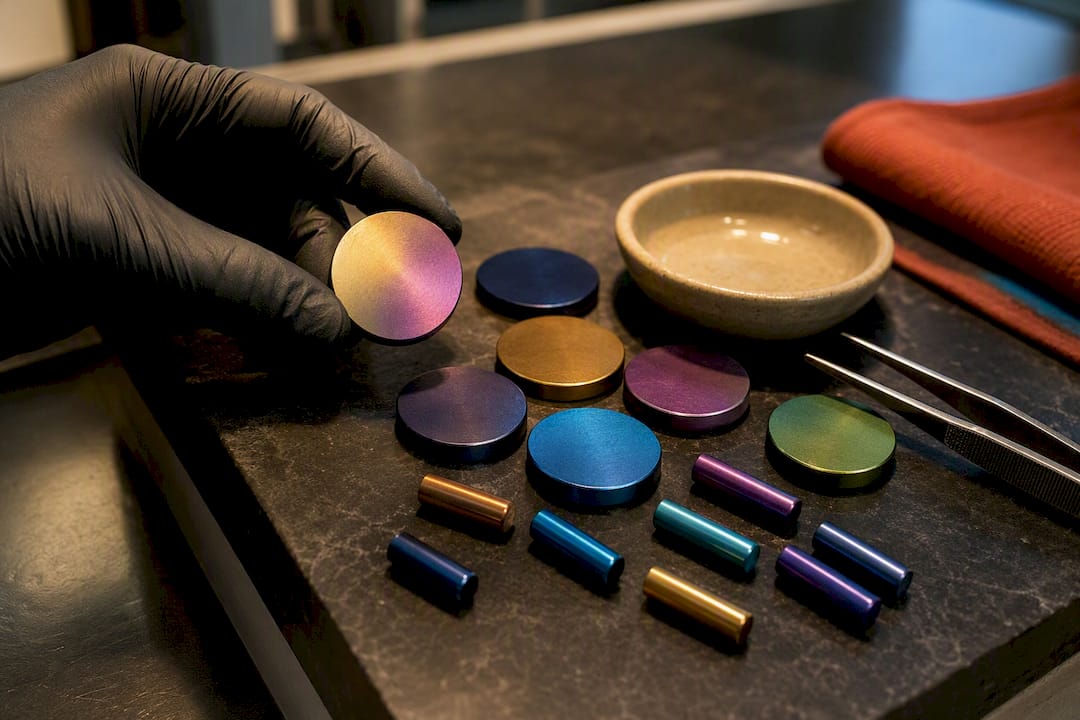
Niobium. If titanium still bothers a wearer with extreme sensitivity, niobium is usually the next stop. It’s biocompatible, hypoallergenic in the material sense, and it can be anodized into a wide range of colors without any coating that could wear off, since the color comes from oxidation of the metal itself rather than a surface layer. It’s a favorite for new piercings on people who’ve already had a bad reaction to something else.
High-karat gold. Pure gold doesn’t react with skin, but pure gold is too soft for most jewelry, so it’s alloyed with other metals for strength. Fourteen and eighteen-karat gold generally contain less alloy material overall, which lowers the odds of a reactive metal sneaking in, but only if that alloy is explicitly nickel-free. Yellow and rose gold are typically alloyed with copper and silver, which most people tolerate fine. White gold is the exception to watch: it often gets its color from nickel alloying, then gets a rhodium plating over the top to look bright. Once that plating wears thin, the nickel underneath is back in contact with skin.
Stainless steel. This is where a lot of shoppers get misled. “Surgical steel” sounds medical and safe, but 316L stainless steel, the grade most commonly used, contains nickel. It resists corrosion well, and plenty of people wear it without issue, but corrosion resistance and nickel-free are two different properties entirely. For someone with a confirmed nickel allergy, 316L is a gamble, not a guarantee, and lab nickel-release testing is really the only way to know for sure how much a given piece sheds.
It’s generally well tolerated, but cheaper sterling can cut corners with nickel in the remaining alloy, and rhodium-plated sterling faces the same wear-through issue as plated white gold.
Tantalum and tungsten. Tantalum behaves a lot like titanium: biocompatible, dense, and rarely a source of reactions. Tungsten needs a caveat, though. Tungsten carbide rings are sometimes bonded with cobalt, and cobalt is its own well-documented allergen, so a tungsten band isn’t automatically a safe bet just because tungsten itself is inert.
For initial piercings versus healed skin, the standards get stricter. Fresh piercings are essentially open wounds, so the Association of Professional Piercers recommends sticking to implant-grade titanium, niobium, platinum, or 14k-plus nickel-free gold until healing is complete. Once skin has fully healed, high-quality sterling or well-plated gold becomes a reasonable option for people with mild sensitivity, though anyone with confirmed nickel allergy is usually better off staying with solid metal long-term.
Pro Tip: If you’re not sure which category your sensitivity falls into, start any new piece on a low-friction area, like a pendant against your collarbone, for a few days before committing to daily wear on a spot like your fingers or ears.
How to Spot a Reactive Piece Before You Buy It
Most bad reactions trace back to a listing that didn’t say enough, not a metal that’s inherently unsafe. Before adding anything to your cart, run through this:
- Check for a specific alloy or karat, not just a buzzword. “Nickel-free 14k gold” tells you something concrete. “Hypoallergenic” by itself tells you nothing.
- Look for plating thickness or vermeil specs. Gold vermeil requires a minimum thickness of gold over sterling silver by law in the US; thin gold plating over base metal has no such requirement and can wear through in weeks.
- Identify what the posts, backs, and clasps are made from, since these touch skin longest and are often a different metal than the visible front. A full disclosure of every component, not just the part you can see, is what separates a trustworthy listing from a vague one.
- Ask for mill certificates or ASTM references if you’re buying for a new piercing or known severe allergy. A seller who can’t answer which titanium grade they use is a seller who probably doesn’t know either.
- Treat “medical grade” and “surgical” as red flags on their own. Neither term is regulated the way ASTM F136 or F67 is, and both get slapped on products that wouldn’t survive an actual materials test.
If something does cause redness, swelling, or itching after wearing it, a simple patch test with a dermatologist can confirm whether nickel (or another metal) is the trigger. Cleveland Clinic recommends identifying the specific irritant rather than guessing, since contact dermatitis from metal can look a lot like reactions from lotion, soap, or fabric.
Matching the Metal to Your Sensitivity Level
Not everyone needs titanium for a pair of hoop earrings. The right metal depends on how reactive your skin actually is.
- Mild sensitivity (occasional redness after long wear): rhodium-plated sterling silver or well-made 316L stainless steel works fine for occasional pieces, as long as you’re not wearing them constantly.
- Moderate sensitivity (regular irritation, some itching): move to solid 14k or 18k nickel-free gold, or platinum, for anything worn daily, and check the difference between plated and gold-filled construction before assuming a “gold” listing means solid metal.
- Severe sensitivity (confirmed nickel allergy, reactions to most metals): stick to implant-grade titanium, niobium, tantalum, or verified platinum, and skip plated pieces entirely, since even a thin barrier layer eventually wears through.
Pro Tip: When in doubt, ask the seller directly whether the piece is solid metal all the way through or plated over a base. A seller who hesitates or dodges the question has already told you the answer.
Before checkout, it’s worth revisiting which materials actually suit sensitive skin so the piece you pick matches how often and how long you plan to wear it.
Caring for Hypoallergenic Jewelry So It Stays That Way
Even the right metal can start causing problems if it’s not cared for properly. Clean pieces with mild soap and a soft brush rather than harsh jewelry cleaners, and keep chlorine, perfume, and hairspray away from direct metal contact since those chemicals accelerate plating wear and can irritate skin further.
- Rinse and dry jewelry after swimming or heavy sweating.
- Retire or replate gold-plated and rhodium-plated pieces once the base layer starts showing through.
- Rotate pieces worn daily rather than leaving one item on your skin around the clock.
- Store items separately to avoid scratches that expose base metal early.
For a full walkthrough on extending the life of plated finishes, Trinitycarter’s cleaning guide covers the specifics.
What the Experts and Standards Actually Say
“Jewelry for initial piercings should be made from implant-grade titanium (ASTM F136), niobium, platinum, or 14 karat or higher nickel- and cadmium-free gold.” This is the working standard piercing professionals use, and it’s built around materials with documented biocompatibility data rather than marketing language.
The Association of Professional Piercers built that guidance around materials that have actual biocompatibility documentation behind them. Dermatology sources back the same logic from the skin side: identify the specific metal causing trouble, then avoid it categorically rather than trusting a label that says “surgical” or “medical grade,” since neither term is tied to a verifiable spec.
How Trinity Carter Approaches Sensitive Skin
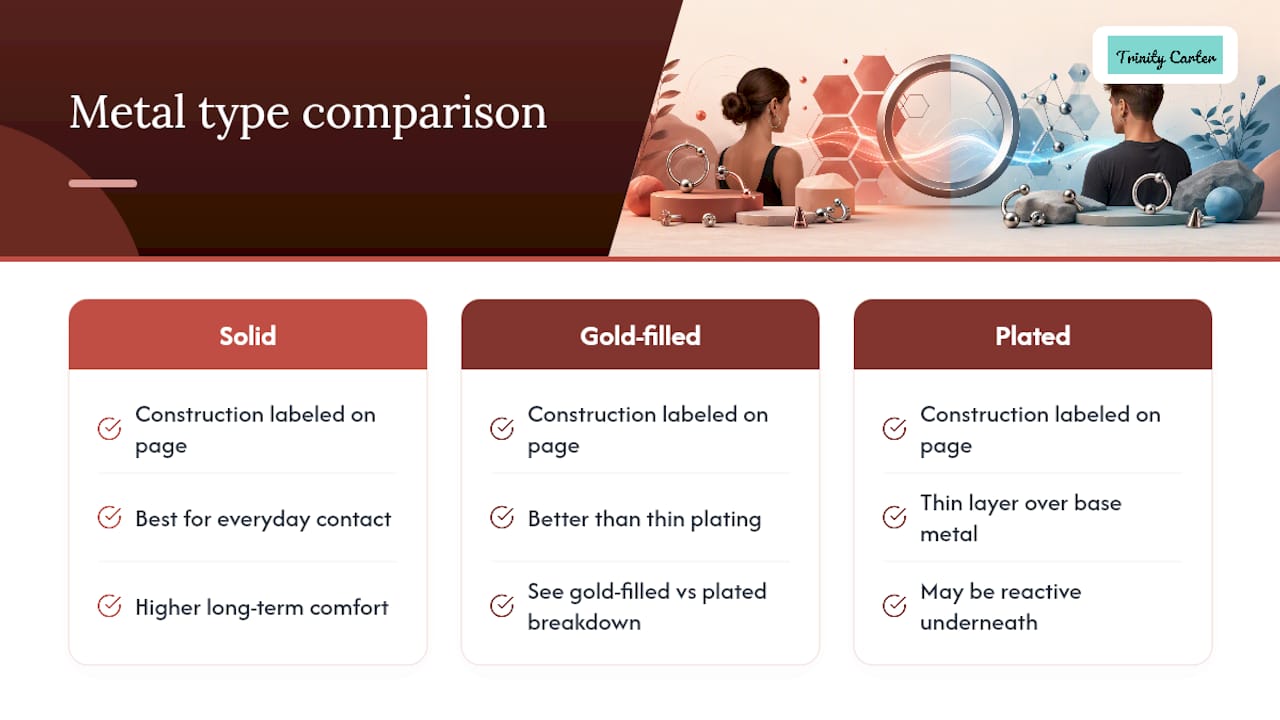
Trinity Carter lists alloy content and plating details on every product page, so you know whether a piece is solid, vermeil, or gold-plated before it reaches you. Solid and gold-filled pieces get recommended for daily wear; plated designs suit occasional styling.
Shop Nickel-Conscious Collections at Trinity Carter
Trinity Carter is the option for readers who want the plating question answered before checkout, not after a rash shows up. Every collection page states whether a piece is solid metal, gold-filled, or plated, so you’re not stuck guessing whether your new ring is 18k gold through and through or a thin layer over something reactive underneath.
If solid metal and long-term comfort matter more to you than a rock-bottom price, browse the rings collection or the bracelets collection for pieces built for everyday contact rather than occasional styling. For readers weighing gold-filled against thin plating, the breakdown on gold-filled versus gold-plated construction is worth a read before you buy. Ready to see the details for yourself? Check the metal and plating specs listed on the Essential V Bracelet product page and add it to your cart if it fits what your skin needs.
If you’re exploring non-metal alternatives for pieces that never touch a chain or clasp, cork jewelry offers a nickel-free option worth knowing about for certain accessory categories.
Trinity Carter’s Take on Buying for Sensitive Skin
Most guides treat “hypoallergenic” as a single tier of safety. It isn’t. There’s a wide gap between a piece that’s genuinely inert against skin and one that’s simply avoided the worst offender for a few weeks before the plating wears down. The industry’s habit of stamping “hypoallergenic” on anything without nickel visible on the surface, while ignoring what’s underneath the plating, is the actual source of most repeat reactions.
The more useful question isn’t “is this hypoallergenic?” It’s “what happens to this piece after 100 wears?” Plated jewelry can be perfectly reasonable for something you wear twice a month. It’s a poor match for a ring you never take off. That’s not a knock against plating as a category. It’s a mismatch between product and use case, and it’s on sellers to be specific enough that shoppers can make that call themselves instead of relying on a label that was never regulated in the first place.
— Trinity
Sources
- Jewelry for Initial Piercings – Association of Professional Piercers
- NIH / NCBI review on metal allergy and piercings
- Contact dermatitis — Cleveland Clinic
- Nickel allergy — American Academy of Dermatology
