

In fashion jewelry, “crystal” most often means faceted decorative glass, sometimes lead-enhanced, not natural quartz. It can throw off serious sparkle, but it’s softer and more prone to surface wear than harder simulants like cubic zirconia. Whether that matters depends entirely on how often you plan to wear the piece and how long you want it to keep looking new.
TL;DR:
- Higher-quality crystal-style glass feels heavier and exhibits sharper, more energetic flashes than cheap glass, indicating better cutting and material formulation.
- Surface wear and facet rounding appear faster on glass-based stones, meaning condition over time is a more reliable value indicator than initial sparkle.
- Leaded or enhanced glass refracts light actively, but long-term durability depends on wear frequency; daily wear favors cubic zirconia for better resistance.
- Proper cleaning and storage prolong the life of crystal-style jewelry, but once facets are worn down, professional polishing or replacement is often necessary.
- Crystal on a product page typically signals enhanced glass, not mineral content, with higher-quality pieces offering finer faceting and better cut precision.
Table of Contents
- Crystal vs Glass: How to Spot the Difference
- Does a Sparklier Stone Mean Better Value?
- How to Keep Crystal-Style Stones Looking Sharp
- Crystal-Style Glass or Cubic Zirconia? A Quick Decision Guide
- Why Trinity Chooses Crystal-Style Stones
- Find Your Next Piece and Keep It Sparkling
- Sources
- FAQ
Crystal vs Glass: How to Spot the Difference
You don’t need a jeweler’s loupe budget to figure out what’s actually sitting in your ring or bracelet. A few observable checks will get you most of the way there, and they work whether you’re standing at a counter or squinting at product photos online.
Start with weight. Lead or heavy-metal oxides in enhanced glass increase density, so higher-quality crystal-style pieces tend to feel heavier in the hand than cheap glass of the same size, according to Britannica’s overview of glass composition. A stone that feels suspiciously light for its size is usually a thin, low-grade glass fill.
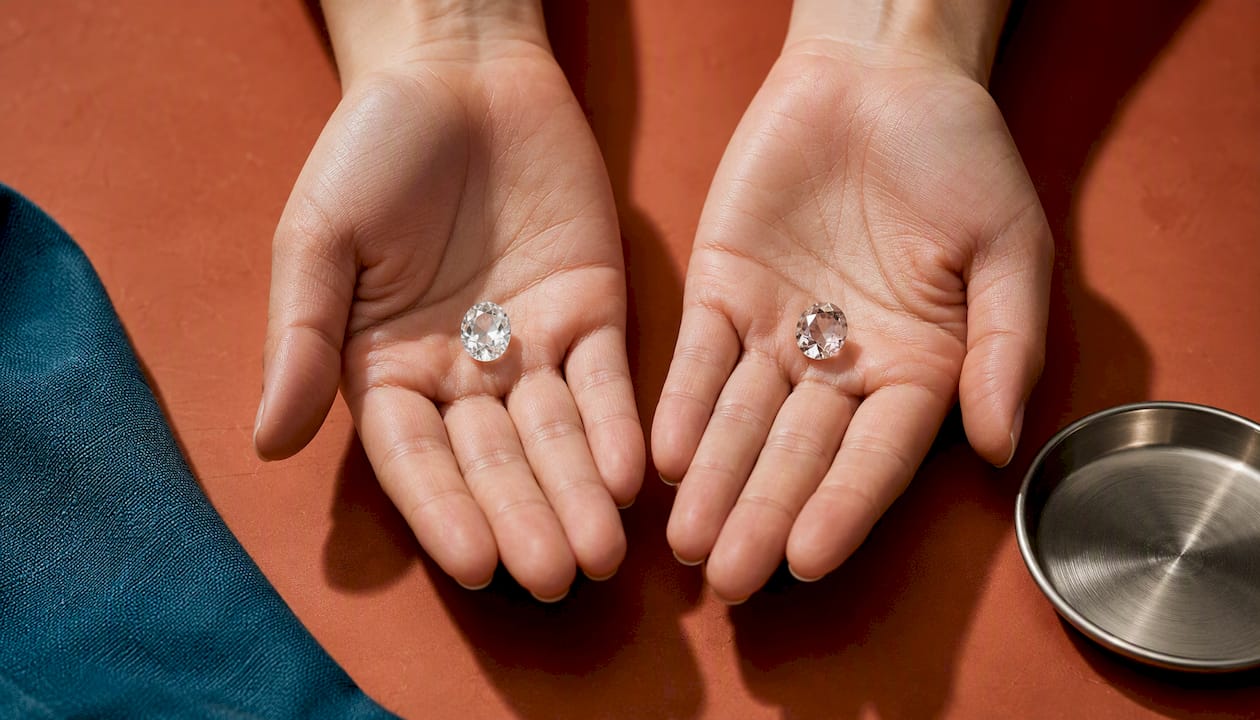
Watch how it catches light. Better crystal-style glass shows sharper, more energetic flashes with clear separation between highlights, while ordinary glass tends to look flatter and more uniform. That crisper “fire” is one reason cut quality matters as much as the raw material.
Grab a loupe if you have one. Manufacturing bubbles, flow lines, and a perfectly uniform interior all point to manufactured glass. Natural inclusions or growth patterns would suggest actual quartz, though that’s rare in mass-market fashion jewelry. Specialists recommend reading weight, facet definition, internal character, and wear together rather than trusting a single clue, since surface brilliance alone can be misleading.
Here’s a quick sequence to run through before you buy:
- Pick up the piece and gauge its heft against a similarly sized item you already own.
- Tilt it under a lamp and check whether the highlights separate cleanly or blur together.
- Look at facet junctions for crisp lines versus soft, rounded edges.
- Check stress points, drill holes, prong contact areas, table edges, for early rounding or dullness.
- Note the mounting: foil backing and mold-made settings usually signal mass-produced glass, while hand-finished settings often house better material.
Pro Tip: Photograph the stone next to a window in natural light. Camera flash tends to flatten sparkle and hide the separation between a good cut and a mediocre one, so daylight gives you a truer read.
Does a Sparklier Stone Mean Better Value?
A piece can look genuinely luxurious with decorative glass at its center, and that’s not a trick. Leaded or optically enhanced glass refracts light more actively than plain glass, and a skilled cutter can amplify that effect until it rivals far pricier materials in photos and under store lighting.
But initial sparkle is a poor predictor of long-term value. Condition, not first impression, is what determines whether a piece still looks good a year from now. Fine scratches, bruised facet edges, and clouding show up faster on glass and lead crystal than on quartz or cubic zirconia, and once those edges round off, the fire that sold you on the piece fades with them.
There’s also a labeling issue worth knowing before you shop:
- “Crystal” on a product page is usually a marketing term for optically lively glass, not a claim about mineral content.
- Rhinestones sold as crystal and rhinestones sold as glass are both glass-based; the real difference is formulation and cut precision, with higher-quality crystal-style stones carrying more mineral content and finer faceting, per CrystalParade’s breakdown of rhinestone grades.
- Many manufacturers have moved away from lead entirely, yet the word “crystal” sticks around because it signals a more refined, better-cut glass.
Judge a piece by what it will look like in six months of real wear, not by how it photographs on day one.
How to Keep Crystal-Style Stones Looking Sharp
Expect gradual wear rather than sudden failure. The telltale signs are fine surface scratches, facets that lose their crisp edge, and a slight cloudiness that dulls reflections, all of which show up faster on glass-based stones than on harder materials.
Cleaning is simple, but a few habits protect the finish:
- Use warm water with a mild soap and a soft brush to loosen buildup around prongs and settings.
- Rinse gently and dry completely before storing, since trapped moisture dulls both the stone and any gold plating.
- Skip ultrasonic and steam cleaners on plated settings. The vibration and heat can loosen glued stones or strip plating over time.
- Store pieces separately, in a lined box or soft pouch, so stones don’t rub against harder metal edges.
- Take jewelry off before cleaning, showering, or exercising to cut down on abrasion and chemical exposure.
Pro Tip: If a stone looks dull even after cleaning, don’t assume it’s ruined. A jeweler can often re-polish rounded facet edges or reset a stone that’s come loose, which is far cheaper than replacing the whole piece.
If sparkle doesn’t come back after a proper cleaning, that’s usually a sign the facets themselves have worn down, and it’s time to ask a jeweler about a professional polish or stone swap.
Crystal-Style Glass or Cubic Zirconia? A Quick Decision Guide
Your wear pattern should drive this choice more than anything else. Here’s a simple way to think about it:
- Wearing it occasionally, for events or evenings out? Crystal-style glass is a fine choice. Its sparkle is excellent, and infrequent wear limits the abrasion that causes clouding.
- Planning to wear it daily? Lean toward cubic zirconia or another harder simulant. Cubic zirconia resists surface abrasion better than glass-based stones and holds crisp facet edges much longer under everyday knocks.
- Buying online? Check the return policy and any listed care instructions before checkout. A seller who explains how to clean and store a piece usually stands behind its quality.
- Judging from photos alone? Look closely at the mounting and setting quality. Clean prong work and precise facet photography are better longevity signals than sparkle alone.
Why Trinity Chooses Crystal-Style Stones
We use crystal-style glass in designer-inspired pieces because it delivers real sparkle at a price point everyday jewelry lovers can actually justify. That’s the trade-off we’re upfront about: gorgeous shine, with care needs that differ from harder stones.
We select and finish our stones and settings to balance that look against longevity, favoring cut quality and secure mounting over cutting corners that show up as wear within months. For pieces meant to survive daily rotation, we point customers toward cubic zirconia options instead. If you already own a crystal-style piece, our crystal jewelry guide walks through styling and upkeep in more detail.
— Trinity
Find Your Next Piece and Keep It Sparkling
If the sparkle described above is what you’re after, designs are built to achieve that exact look for real, regular wear, not just a single photo. Our bracelet collection and ring collection both include crystal-style pieces finished with secure settings so the shine lasts longer than a one-season fling.
If you know you’ll wear something daily, start with our cubic zirconia buying guide to see which cut and setting combinations hold up best. And once a piece arrives, our cubic zirconia care routine takes under ten minutes and keeps stones looking freshly polished. Before you check out, glance at the return window and care notes listed on the product page, then pick the piece that matches how often you’ll actually wear it.
Sources
For material definitions and identification methods, see Britannica’s entry on glass and VelvetMatter.art’s guide to rock crystal, lead crystal, and cut glass.
- Glass | Britannica
- Velvetmatter
- Glass Rhinestones vs Crystal Rhinestones: What’s the Difference? | CrystalParade
FAQ
Is Crystal Better Than Glass for Everyday Jewelry?
Not necessarily. Crystal-style glass sparkles beautifully but wears faster than cubic zirconia, so for daily wear, a harder simulant usually holds its shine longer.
What’s the Real Difference Between Crystal and Glass in Jewelry?
Both are glass-based; “crystal” usually refers to glass formulated or cut to boost refraction, while plain glass lacks that extra optical treatment, according to Britannica.
How Can I Tell if a Stone Is Crystal or Cheap Glass?
Check weight, facet sharpness under light, and wear at stress points like prongs and drill holes. Combined evidence beats trusting the word “crystal” on a label alone.
Does Crystal Jewelry Scratch Easily?
Yes, compared to cubic zirconia or quartz. Fine scratches and clouded facets show up faster on glass and lead crystal with regular wear.
Should I Choose Cubic Zirconia Instead of Crystal?
For pieces worn daily, yes. Cubic zirconia resists abrasion better and keeps crisper edges over time, making it the stronger pick for everyday rings and bracelets, while crystal-style glass suits occasional, special-event wear.
