

For everyday, water-safe jewelry, 316L stainless steel and PVD-coated stainless steel are the most reliable choices, with gold-filled or solid gold as pricier upgrades. The catch: “waterproof” almost always means resistant to sweat, rain, and hand washing, not built to survive daily pool laps or ocean swims.
TL;DR:
- PVD-coated stainless steel offers the best balance of water resistance, durability, and price for daily jewelry that withstands water and skin contact.
- Gold-filled jewelry lasts significantly longer than plated pieces due to a thicker gold layer, making it ideal for long-term wear, especially over years.
- Extended exposure to chlorine, saltwater, and harsh chemicals accelerates coating wear, so jewelry should be removed before swimming or hot tub use.
- Cheaper jewelry tends to use electroplating on base metals like brass or copper, which quickly tarnish or green with moisture and oils.
- Higher-priced options like solid gold or high-quality gold-filled pieces perform better long-term but require careful handling to avoid scratches and damage.
Table of Contents
- What Causes Jewelry to Tarnish?
- Stainless Steel vs. Gold-Filled vs. Vermeil vs. Solid Gold
- Can You Shower, Swim, or Work Out in Tarnish-Resistant Jewelry?
- How Long Should Tarnish-Resistant Jewelry Actually Last?
- What to Check Before You Buy Tarnish-Resistant Jewelry
- How to Keep Tarnish-Resistant Jewelry Looking New
- Is Cheap Tarnish-Resistant Jewelry Actually a Good Deal?
- Common Myths About Tarnish-Proof Jewelry
- How Trinity Carter Thinks About Plating and Everyday Wear
- Trinity Carter Picks for Low-Maintenance, Everyday Jewelry
- Sources
What Causes Jewelry to Tarnish?
Tarnish happens when a metal’s surface reacts with air, moisture, sulfur compounds, or skin oils and oxidizes. You’ll see it as dulling, dark spots, or that greenish cast that shows up on cheaper rings after a humid week. It’s a surface chemistry problem, not a design flaw, but which metal sits under the finish decides how bad it gets and how fast.
Base metal choice matters more than almost anything else on the spec sheet. Brass and copper cores oxidize quickly and often leave that green residue on skin, while 316L surgical-grade stainless steel resists corrosion on its own and stays hypoallergenic, which is why it’s become the standard core for pieces marketed as tarnish-free.
The coating on top changes the durability math further:
- Electroplating deposits a thin gold layer through an electric current. It looks great fresh out of the box but wears thin within months of daily contact.
- PVD (Physical Vapor Deposition) bonds gold to metal at a molecular level, producing a harder, more scratch-resistant finish that holds up far longer than standard plating.
- Gold-filled pieces mechanically bond a genuinely thick layer of gold to a base core, so there’s more material to wear through.
- Vermeil means sterling silver with a gold layer on top. The silver underneath can tarnish if the coating thins.
Stainless Steel vs. Gold-Filled vs. Vermeil vs. Solid Gold
Picking a material really comes down to how you weigh cost against how long you want to stop thinking about your jewelry entirely.
- 316L stainless steel with PVD coating: the best balance of price, water resistance, and skin friendliness. It won’t tarnish even if the coating eventually scratches through, because the core underneath is stainless.
- Gold-filled: a much thicker gold layer than plating, which means better long-term color retention. You pay more upfront, but it ages better than any plated piece.
- Vermeil: heavier gold over sterling silver, so it looks and feels closer to solid gold. Performance around water is inconsistent. Some vermeil holds up fine; some develops a silvery tinge within a year of regular wear.
- Solid 14k+ gold: doesn’t tarnish, period, because there’s no coating to fail. It’s the most expensive option and the metal is softer, so it scratches and bends more easily than stainless.
Pro Tip: If you’re torn between gold-filled and vermeil, ask what’s underneath the gold. Gold-filled almost always has a brass or stainless core; vermeil is silver. Silver is the one that reacts with humidity over time.
Someone buying a gift under $50 should lean stainless and PVD. Someone building a ten-year wardrobe piece should lean gold-filled or solid gold. For a deeper breakdown, this gold-filled vs. gold-plated comparison walks through the math.
Can You Shower, Swim, or Work Out in Tarnish-Resistant Jewelry?
Mostly yes, with real limits. Everyday exposure like hand washing, rain, sweat at the gym, and the occasional dish-washing session is exactly what stainless steel and PVD coatings are built for. Prolonged submersion is a different story entirely. Pool chlorine, saltwater, and hot tub chemicals accelerate wear on any coating, and manufacturers of PVD stainless pieces specifically warn against extended time in chlorinated or salt water, even though the metal itself won’t rust.
A short list of what actually shortens jewelry life:
- Chlorine and salt water — remove rings and bracelets before pool or beach swims longer than a quick dip.
- Perfume and lotion — apply these before putting jewelry on, not after, since alcohol and oils degrade finishes over time.
- Abrasive cleaning products — dish soap is fine; bleach and scouring powders are not.
- Hard workouts with friction — barbells and resistance bands can scuff plating faster than casual wear.
- Drying — pat pieces dry after any water exposure instead of letting them air dry, since trapped moisture speeds tarnish on any metal.
How Long Should Tarnish-Resistant Jewelry Actually Last?
PVD-coated stainless steel typically holds its finish for 1 to 2 years, sometimes longer under normal daily wear like handwashing and light sweat. Gold-filled pieces often last significantly longer than plated pieces before the gold layer thins noticeably. Solid gold, barring damage, lasts decades because there’s no coating to lose.
The pattern to remember: thicker gold layer, longer life, higher price. That’s not marketing, it’s physics.
Watch for early warning signs: a color shift at edges and high-contact points (clasps, ring bands), or a slight yellowing that looks less bright than when you bought it. At that stage, a gentle cleaning often restores shine. Once you see base metal peeking through, replacement is more sensible than repair.
What to Check Before You Buy Tarnish-Resistant Jewelry
A product page that skips the base metal entirely is telling you something. Run through this list before adding anything to your cart:
- Base metal named explicitly — look for “316L stainless steel,” not vague terms like “premium alloy.”
- Coating type specified — PVD outperforms standard electroplating, and a legitimate seller will say which one you’re getting.
- Hypoallergenic claims backed by material — nickel-free stainless and gold-filled pieces are genuinely safer for sensitive skin; check this sensitive-skin jewelry guide if reactions are a concern.
- Clasp and solder quality — a well-finished clasp often outlasts the decorative plating around it, so ask what the hardware is made from, not just the visible finish.
- Warranty or return policy — brands confident in their coating tend to back it with a multi-year warranty.
Pro Tip: Message the seller directly and ask, “What’s the base metal, and what happens if the coating fades in a year?” A confident, specific answer is worth more than five-star reviews.
Red flags worth walking away from: “waterproof forever” claims with no material listed, prices too low to plausibly cover a PVD process, and stock photos with no close-up of the actual clasp or hardware.
How to Keep Tarnish-Resistant Jewelry Looking New
Even the best coating benefits from basic habits. Store pieces separately in a soft pouch or lined box rather than tossed together in a drawer, since metal-on-metal contact scratches finishes faster than anything else. Put jewelry on last when getting ready, after perfume, hairspray, and lotion have dried, and take it off first when you get home.
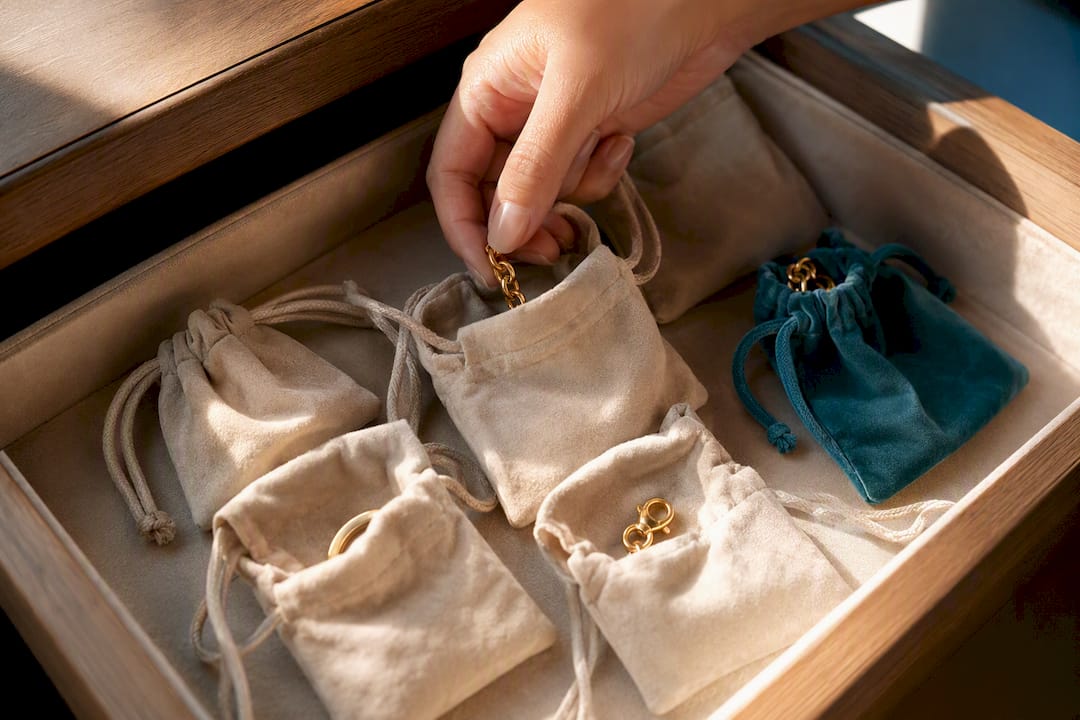
For actual cleaning, warm water with a drop of mild dish soap and a soft cloth handles most daily grime. Skip ultrasonic cleaners and anything with ammonia or bleach on plated pieces, since those chemicals attack the coating directly rather than just the surface dirt. A microfiber cloth after each wear, wiping away sweat and oils, does more for longevity than any occasional deep clean.
If you exercise heavily or work with your hands, consider a simple rule: rings and bracelets come off for anything involving heavy friction, chemicals, or prolonged water. Earrings and necklaces tolerate more day-to-day contact since they see less direct abrasion. This plating primer breaks down exactly how a finish degrades layer by layer, which makes the “why” behind these habits easier to remember than a bare rule list.
Is Cheap Tarnish-Resistant Jewelry Actually a Good Deal?
Price in this category tracks almost directly with how much real gold or protective coating you’re getting, so a $15 ring and a $150 ring are rarely competing on the same terms.
Budget pieces (roughly $10 to $40) are usually electroplated brass or basic stainless without PVD. They look fine for a season, then fade or discolor faster, especially with water exposure. Mid-range pieces ($40 to $100) typically bring PVD-coated 316L stainless into the mix, which is where the value curve bends sharply in your favor. You’re paying maybe two or three times more than the bargain bin, but getting several times the lifespan and real water tolerance.
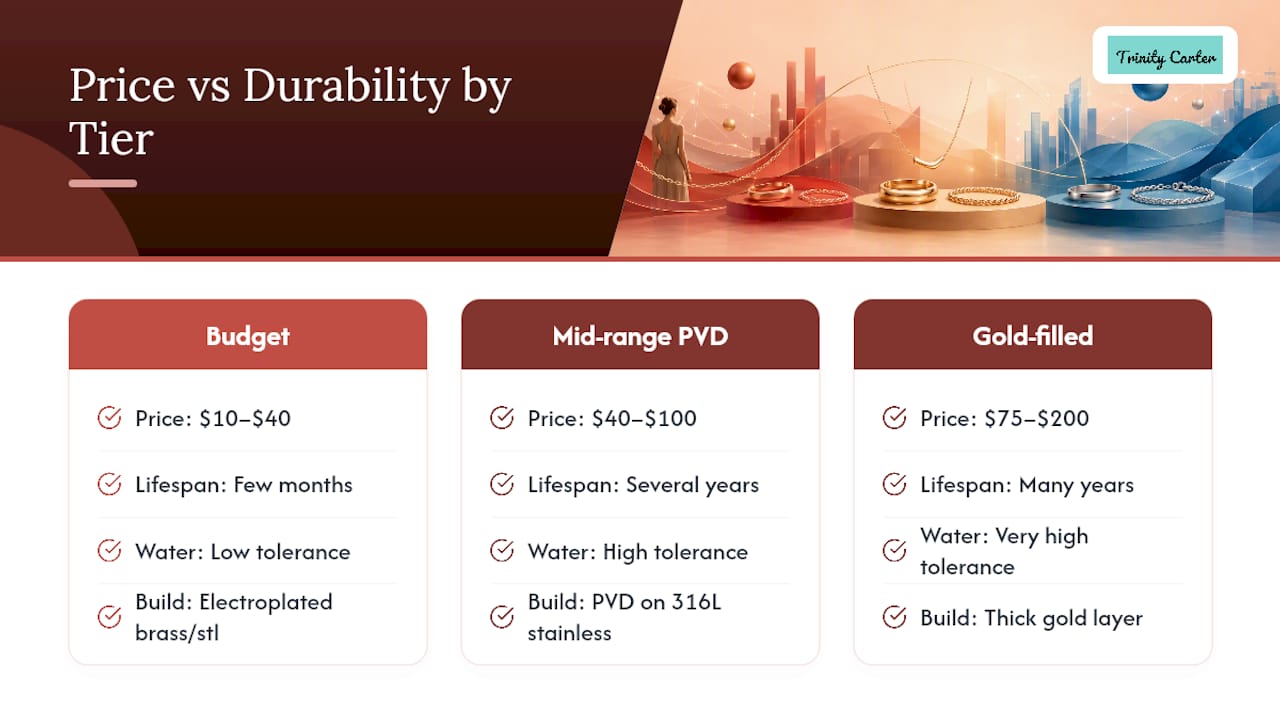
Gold-filled pieces sit higher, often $75 to $200 depending on the design, and that premium buys a gold layer thick enough to survive years of daily wear rather than months. Solid gold starts well above that and functions less like a fashion purchase and more like an asset, since it holds value and never needs replating.
The smartest money, for most shoppers wanting genuinely low-maintenance daily jewelry, sits in that mid-range PVD stainless bracket. It’s the point where durability improves dramatically without crossing into heirloom pricing, and it’s exactly why editorial roundups keep pointing shoppers toward stainless and PVD builds for daily rotation pieces.
Common Myths About Tarnish-Proof Jewelry
The word “waterproof” gets stretched further than it should. It typically means water-resistant for showers, sweat, and rain, not cleared for laps in a chlorinated pool. Treating any coated jewelry as truly indestructible around water is the fastest way to shorten its life.
Another persistent myth: that green stain on your finger means the jewelry is “fake” or low quality. It’s actually copper or brass reacting with moisture and skin oils, a chemical reaction that can happen even in jewelry that’s otherwise well made. It’s a material issue, not necessarily a craftsmanship one, and sellers who explain this upfront tend to be more trustworthy than ones who dodge the question.
There’s also a common assumption that “hypoallergenic” and “tarnish-resistant” mean the same thing. They don’t. A piece can resist discoloration while still containing trace nickel that irritates sensitive skin, so check both claims separately rather than assuming one guarantees the other.
Finally, plenty of shoppers assume higher price always equals better performance. It often does, but not always: a mediocre vermeil piece can underperform a well-made PVD stainless piece at a fraction of the cost, because the base metal and coating process matter more than the sticker price alone. Reading the plated vs. vermeil breakdown before assuming “more expensive” means “more durable” saves a lot of buyer’s remorse.
How Trinity Carter Thinks About Plating and Everyday Wear
We build around the same principle this whole guide leans on: the base metal and the bonding process matter more than any marketing label. That’s why our approach favors properly finished plating over thin electroplating that fades within a season, and it’s why we’re upfront that “gold-plated” and “gold-filled” perform differently over time. Our gold-plated versus gold-filled explainer walks through that distinction in more depth than most product pages bother to.
We don’t market anything as indestructible. A piece worn daily, including through workouts and hand washing, should hold its color and shape for a long stretch of regular wear, but no plated finish survives careless treatment forever. Setting that expectation honestly, rather than promising eternal shine, is what actually earns repeat customers instead of one-time buyers who feel misled six months later.
— Trinity
Trinity Carter Picks for Low-Maintenance, Everyday Jewelry
Trinity Carter designs with daily wear in mind, not display-case wear. The Essential V Bracelet and its matching Essential V Necklace Pendant use finishing built to handle hand washing, sweat, and normal weather exposure without babying, and the Essential V Earring Studs round out the set for a no-fuss daily stack.
Expect these pieces to hold their color through the kind of week that includes showers, workouts, and a full workday of hand contact. Provided you skip pool chemicals and pat them dry after any splash. A soft cloth wipe after wear and separate storage will get you the most life out of the finish. Browse the full bracelet collection or check the necklace collection to find a piece that matches how you actually live, then add it to your cart and see how it holds up in your own daily rotation.
Sources
- Tarnish-Free & Waterproof Jewelry Wholesale | Non-Tarnish Gold Supplies
- 12 best tarnishproof jewelry brands of 2025 | CNN Underscored
- Best Waterproof Jewelry Brands of 2026
